The Geometry of Despair
There is something deeply poetic about the fact that Tetris was born in the Soviet Academy of Sciences. While the rest of the world was busy trying to figure out how to make computers do something useful, Alexey Pajitnov was staring at an Electronika 60 and thinking, "What if we took the misery of the Khrushchev-era housing projects and made it addictive?" It is the ultimate irony: a regime that couldn't reliably supply toilet paper managed to export a digital obsession that would eventually consume more human hours than the entire construction of the Trans-Siberian Railway.
The game's logic is the logic of the Khrushchyovka. In the 1950s, Nikita Khrushchev looked at the ruins of post-war Russia and decided that the solution to homelessness was to treat people like cargo. He didn't want buildings; he wanted products. These five-story walk-ups were the architectural equivalent of a TV dinner—cheap, salty, and identical to the one your neighbor was eating. They were built from prefabricated concrete panels that were literally trucked to a site and stacked until they resembled a place where a person might theoretically survive a winter.
Watching a line of Tetris blocks disappear is the only part of the metaphor that doesn't hold up. In the real world, when you perfectly align your concrete modules, they don't vanish. They stay there for sixty years, slowly gathering moss and the quiet resentment of three generations of tenants. If only the Soviet housing ministry had realized that a 'Long I' block could actually solve a structural integrity issue, the USSR might still be standing.
Prefabricated Soul Crushing
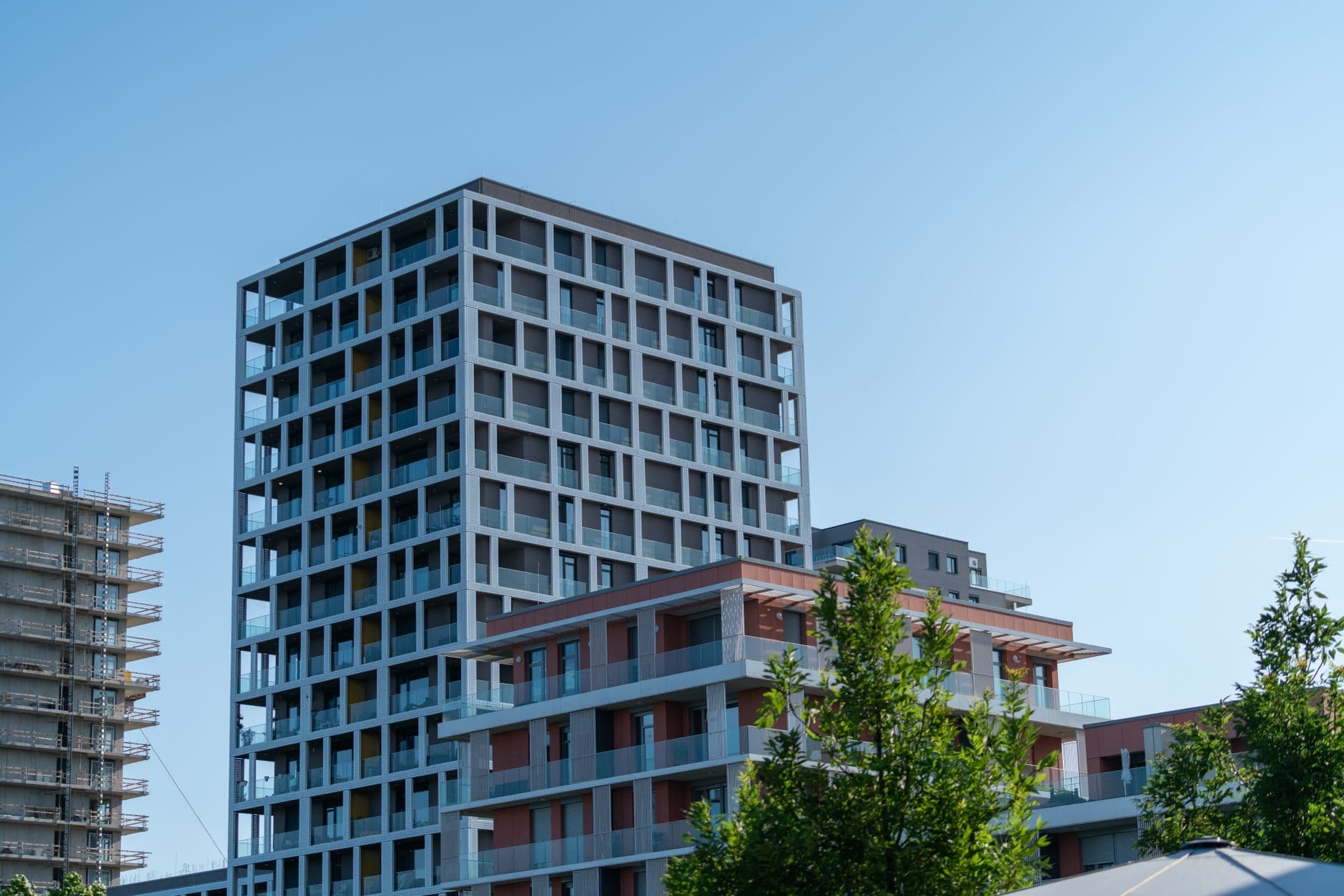
To understand the Khrushchyovka, you have to appreciate the sheer, unbridled hatred for the concept of 'flair.' These buildings were designed to be assembled in two weeks. That is not a typo. You can barely get a permit for a deck in the suburbs in two weeks, but the Soviets were slapping together entire neighborhoods before the concrete had even finished screaming. It was modularity taken to its most nihilistic conclusion. Every apartment had the same layout, the same thin walls, and the same view of another identical block being lowered into place by a crane.

Photo by Q. Hưng Phạm on Pexels
The design wasn't just about speed; it was about the total erasure of the individual. If you can't tell which window is yours from the street, you're much less likely to develop dangerous ideas like 'personality' or 'private property.' It’s the architectural version of a corporate team-building exercise that lasts forever. The blocks were standardized down to the millimeter, much like the tetrominoes we frantically rotate on our phones. The only difference is that if you misplace a block in Tetris, you lose the game. In 1960s Moscow, if you misplaced a block, you just stuffed some extra rags in the gap to keep the snow out.
Modern architects love to talk about the 'honesty' of brutalism and modular design. It’s easy to be honest about a concrete slab when you’re not the one hearing your neighbor’s soup-slurping through it every night at 6:00 PM. The modular movement was a factory-line approach to the human soul, and Tetris was its digital twin—a world where the pieces only fit one way, and the pace only ever gets faster until you inevitably fail.
The High-Tech Return of the Cube
Fast forward to today, and we are right back where we started, except now we call it 'Sustainable Modular Living' and charge $4,000 a month for it. Silicon Valley has discovered the revolutionary idea of stacking boxes on top of each other, apparently unaware that the Soviets did this sixty years ago while wearing much heavier coats. We’ve rebranded the Khrushchyovka as a 'micro-unit' or a 'plug-and-play habitat.' It's the same grey box, just with better Wi-Fi and a communal espresso machine in the lobby.
This new wave of modularity is sold as the ultimate solution to the modern housing crisis. We’re told that by building apartments in factories and 'clicking' them together on-site, we’ll save the planet and lower costs. It’s the same promise Khrushchev made, just wrapped in a more expensive font. The tech industry loves modularity because it treats physical space like software. You can scale it. You can iterate. You can pretend that people are just data points that need to be slotted into a grid.

Photo by cottonbro studio on Pexels
There is a certain smugness in modern sustainable architecture that ignores the psychological toll of living in a repetitive grid. We see these sleek, 3D-printed modular homes and think we've conquered the chaos of the city. In reality, we’re just playing a high-resolution version of the same game Pajitnov coded in 1984. We are still obsessed with the idea that if we can just align the blocks perfectly enough, the problems of urban living will simply disappear. Spoiler alert: the blocks keep coming.
What This Actually Means
History doesn't repeat; it just gets a better graphics card. The obsession with modular housing, whether it’s a Soviet ruin or a luxury 'pod' in Brooklyn, stems from a desire to solve human problems with geometry. We want to believe that the messiness of life can be organized into neat, right-angled containers. It’s a comforting lie that appeals to bureaucrats and software engineers alike because it turns the terrifying complexity of a city into a manageable inventory problem.
Tetris remains the perfect metaphor for this because the game is fundamentally unwinnable. You can play a perfect game for hours, stacking your modules with the precision of a Swiss watch, but the speed always increases. The blocks never stop falling. Eventually, the screen fills up, and the game ends. Applying that same logic to where people live isn't 'innovation'—it’s a confession that we’ve given up on making cities beautiful and settled for making them efficient.
Ultimately, the 'Tetris' style of urbanism is a victory of the grid over the human. It’s the belief that as long as the pieces fit, the picture doesn't matter. We are currently building a future that looks remarkably like the past we spent decades trying to escape, proving once and for all that humanity’s favorite pastime isn't progress—it’s just rearranging the same concrete blocks and hoping for a different result.
Quick Answers
Is modular housing actually the same as Soviet projects?
Technically no, because modern versions have insulation and don't smell like state-mandated cabbage, but the underlying 'Lego-for-adults' philosophy is identical.
Why is Tetris so addictive if it's about Soviet architecture?
Because the human brain is hardwired to find order in chaos, even if that order is a soul-crushing grid of grey rectangles designed by a man in a lab coat.
Will modular buildings solve the housing crisis?
Only if you define 'solving' as 'cramming as many humans as possible into the smallest possible space for the highest possible profit,' which, coincidentally, is exactly how the game is played.