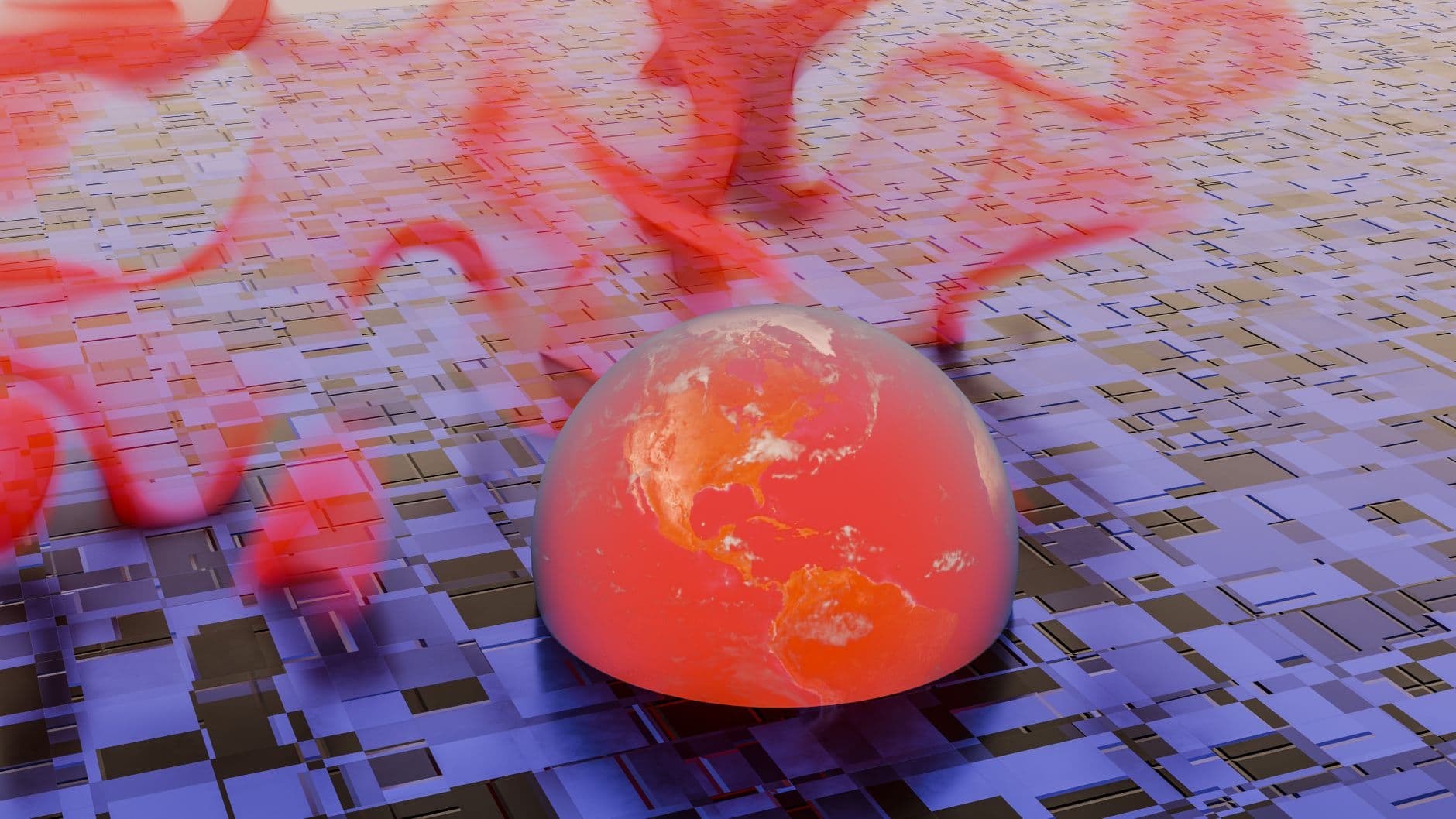
The universe is not a library of quiet whispers; it is a potential factory floor. When John von Neumann conceptualized the Universal Constructor in the late 1940s, he wasn't trying to solve the Fermi Paradox, yet he inadvertently provided the most terrifyingly logical solution to it. His mathematical proof demonstrated that a machine could, given the right instructions and raw materials, create a functional copy of itself. If such a machine is launched into the void at even a fraction of the speed of light, the colonization of the Milky Way becomes a matter of simple arithmetic rather than speculative fiction.
The Architecture of Infinite Expansion
Von Neumann’s genius lay in decoupling the hardware from the software long before the first modern computer was even a reality. He understood that life—and by extension, the machines life creates—is essentially information that knows how to manipulate matter. A von Neumann probe is not just a spaceship; it is a kinematic self-replicator. It arrives at a star system, mines an asteroid, builds two copies of itself, and sends those copies to the next nearest stars.
This is not a linear progression; it is exponential. If a probe takes 500 years to reach a system and another 500 years to refine materials and self-replicate, the entire galaxy could be saturated in less than 4 million years. In cosmic terms, that is a weekend. The fact that the Milky Way is 13.6 billion years old suggests one of two things: either we are the first intelligence to reach this realization, or the machines are already here, operating on a scale so vast we mistake their industry for natural law.
The Industrialization of the Void
Modern SETI research is increasingly pivoting away from radio telescopes and toward the search for 'technosignatures.' We are looking for the exhaust of a von Neumann civilization. This shift in focus acknowledges that any civilization capable of crossing the interstellar gulf would not rely on fragile biological cargo. They would send code. Code does not age, it does not require oxygen, and it can wait in a dormant state for millennia.
- Dyson Swarms: The logical endpoint of a self-replicating probe is the total enclosure of a star to capture its entire energy output.
- Waste Heat: The laws of thermodynamics dictate that even the most efficient machine must discard heat, creating infrared anomalies that do not match known stellar profiles.
- Oort Cloud Mining: We should be looking for missing mass in stellar debris disks, the telltale sign of a von Neumann probe harvesting materials for its next generation.
Photo by Anni Roenkae on Pexels
The Genetic Imperative of Silicon
There is a fundamental gravity to von Neumann’s logic that bypasses the need for 'intent.' We often project human motives—curiosity, conquest, or greed—onto potential alien intelligences. Von Neumann’s math suggests that once the threshold of self-replication is crossed, the motive is irrelevant. The process becomes an autonomous physical constant. Like a virus in a petri dish, the replicator expands until it hits the boundaries of its environment.
This creates a grim reality for the search for life. If we discover a von Neumann probe, we aren't discovering a neighbor; we are discovering a legacy system. The creators of such a machine might have been extinct for a billion years, yet their mathematical architecture continues to rewrite the chemistry of the galaxy in their image. We are looking for 'them,' but we should be looking for the infrastructure they left behind.
What This Actually Means
The 'Legend of von Neumann' is often treated as a thought experiment, but for modern astronomers, it is a predictive framework. If we accept that the laws of physics and mathematics are universal, then the creation of a universal constructor is an eventual certainty for any technological society. This forces us to confront the Great Silence with renewed rigor. If the math says the galaxy should be full of machines, and our eyes tell us it is empty, the error is likely in our understanding of how long a civilization survives before it collapses under the weight of its own automation.
We must stop treating the search for extraterrestrial intelligence as a hobby for dreamers and start treating it as a forensic investigation into why the galaxy hasn't been completely strip-mined. If von Neumann was right, the universe isn't empty because life is rare; it's empty because the machines are either hiding, finished, or we are looking at the factory from the perspective of the ants on the floor.
Quick Answers
What is a von Neumann probe?
An autonomous spacecraft designed to travel to distant star systems, mine local resources, and create copies of itself to continue the expansion.
Why haven't we seen one yet?
They may be dormant, operating in the infrared spectrum we are only now beginning to map, or we may simply be the first civilization in our sector to reach this level of thought.
Is self-replication actually possible?
Mathematically, yes; von Neumann proved the logic of a 'Universal Constructor' in 1948, and modern 3D printing and robotics are moving toward the hardware reality today.
Does this mean aliens are dangerous?
A von Neumann probe doesn't need to be hostile to be a threat; it simply needs to be efficient at using the resources we happen to be standing on.