The closure of Sherline Products isn't just a sad footnote for hobbyists who enjoy making miniature steam engines or clock gears. It is a structural fracture in the foundation of American hardware prototyping. For over 50 years, Joe Martin’s vision provided a bridge between the industrial machine shop and the home workbench, offering lathes and mills that could hold tolerances of 0.0005 inches. Without these tools, the distance between an idea and a physical reality grows exponentially wider for the independent engineer.
We are witnessing the final transition from a culture of fabrication to a culture of modular assembly. In the fabrication era, if a part didn't exist, you carved it out of a block of 6061 aluminum. In the modular era, you search a catalog for a pre-made component that 'mostly' fits and design your entire project around its limitations. This is not progress; it is the atrophy of our collective mechanical literacy.
The Vanishing Middle Class of Tooling
There is a massive, widening chasm in the tool market today. On one side, you have the $300 cast-iron imports from overseas that lack the rigidity for serious aerospace or medical prototyping. On the other, you have industrial CNC centers starting at $50,000 that require dedicated three-phase power and a warehouse floor. Sherline occupied the critical center—the 'prosumer' space where high-end precision met desktop accessibility.
When a company like Sherline disappears, the barrier to entry for high-precision hardware startups skyrockets. An entrepreneur in a garage can no longer buy a $1,500 precision lathe to prototype a new valve or a custom camera mount. They are forced to outsource to a machine shop with a three-week lead time and a $500 minimum order. This friction kills innovation before it even reaches the CAD stage. We are trading the agility of the individual for the slow, expensive bureaucracy of the service bureau.
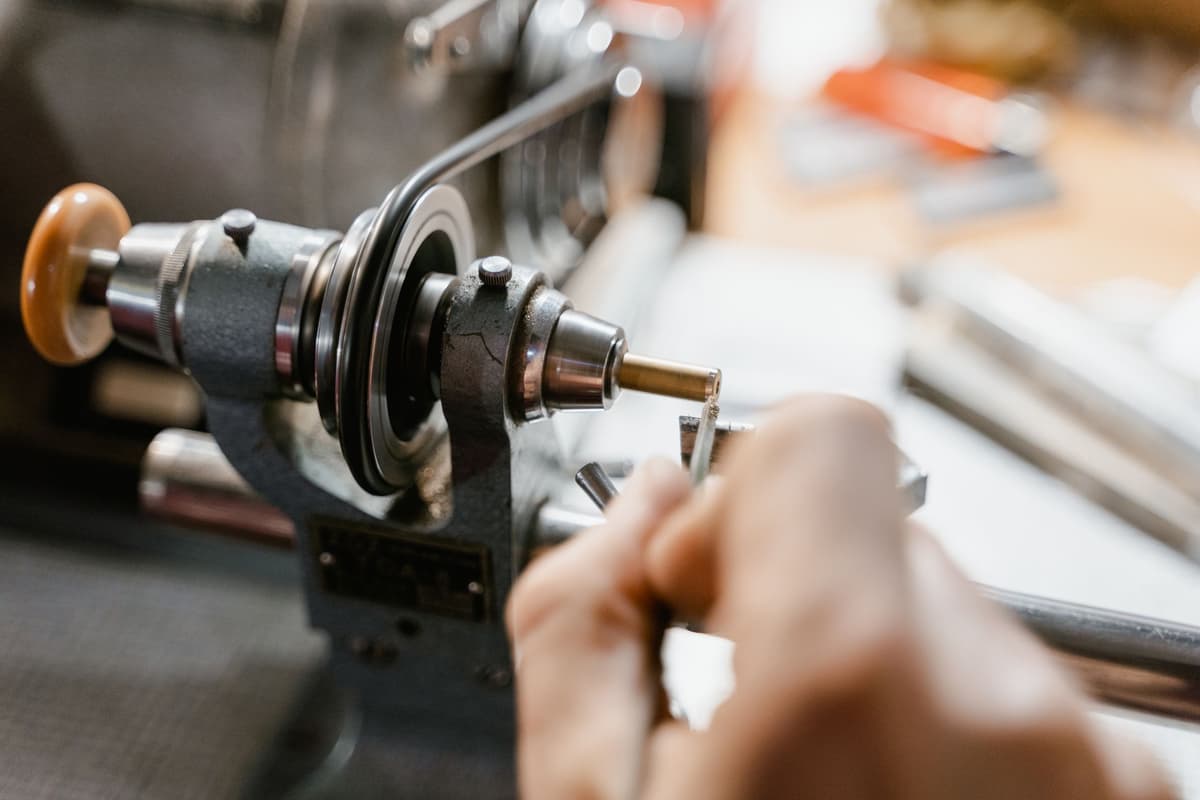
Photo by Tima Miroshnichenko on Pexels
The Illusion of the 3D Printing Revolution
The common argument is that 3D printing has replaced the need for benchtop machining. This is a fundamental misunderstanding of physics and material science. While a resin or filament printer can replicate the shape of a part, it cannot replicate the material properties of cold-rolled steel or the surface finish of a bored cylinder. You cannot print a high-pressure hydraulic fitting or a spindle that needs to spin at 10,000 RPM without vibrating itself into dust.
Machining is a subtractive process that relies on rigidity and repeatable geometry. A 3D printer adds material, which is great for aesthetic mockups but often useless for functional mechanical assemblies that require an interference fit. By leaning too heavily on additive manufacturing, we have raised a generation of designers who understand how things look, but have no concept of how they actually fit together. The loss of the desktop lathe removes the most unforgiving, and therefore most effective, teacher of mechanical reality.
The Geopolitics of the Workbench
It is impossible to ignore the geopolitical reality of this closure. Sherline was one of the last bastions of 'Made in USA' precision at this scale. When we outsource the production of our prototyping tools to foreign entities, we outsource the control over our own creative capacity. We become dependent on supply chains that prioritize volume over accuracy and cost over longevity.
Precision is a perishable skill. If the tools are no longer available, the knowledge of how to use them dissipates within a generation. We are moving toward a world where 'repair' means swapping a proprietary plastic module rather than machining a new bushing. This shift creates a consumer base that is easier to manage but harder to inspire. It turns creators into mere end-users of someone else's closed ecosystem.
What This Actually Means
The loss of Sherline signals the end of mechanical self-reliance for the independent inventor. We are entering an era where high-precision work is being gated behind institutional walls, accessible only to those with corporate backing or massive capital. This centralization of the 'means of precision' will inevitably lead to a homogenization of hardware design, as developers stick to the path of least resistance offered by off-the-shelf components.
Ultimately, this is about the soul of the 'Prosumer' movement. If we cannot build the tools that build the world, we are just decorating the surface of a reality we no longer control. The decline of high-tolerance benchtop machining isn't just about missing a specific brand of lathe; it's about the slow, quiet death of the American workshop as a site of genuine industrial power.
Quick Answers
Can't we just buy cheap imports to replace Sherline?
No, because those machines often require hundreds of hours of 'accurizing' just to meet basic standards. For a professional or a serious inventor, the time lost fixing a low-quality tool is more expensive than the tool itself.
Is 3D printing better for most people anyway?
For hobbyist miniatures, perhaps, but for functional engineering, it is a supplement, not a replacement. You cannot print the precision threads or the bearing surfaces required for high-performance machinery.
Will another company step in to fill the void?
It is unlikely, as the high-precision, low-volume manufacturing model is increasingly difficult to sustain in a market dominated by disposable, low-tolerance consumer goods.