Neuroscientists spent decades trying to map the extreme outer perimeter of human cognitive speed using fighter pilots and chess grandmasters. It turns out they were looking in the wrong demographic entirely, because nobody told them about teenagers violently vibrating to K-pop while managing four hundred digital space crabs.
A new wave of behavioral data dubbed the 'Brood War Bench' is currently humiliating everything we thought we understood about the biological speed limit of human consciousness. By hooking up elite players of StarCraft: Brood War to medical-grade eye-trackers and EEG caps, cognitive researchers accidentally discovered that human meat can, in fact, process tactical data faster than raw sensory perception should physically permit. These players are not thinking. Thinking is far too slow, clunky, and humiliatingly human. They have achieved a state of biological automation so unhinged that their hands are solving supply-chain logistics before their visual cortex even files the paperwork.
The Flesh Is Weak, but the Mutalisk Micro Is Fast
To understand why researchers are sweating into their clipboards, you have to appreciate what an ultra-high-speed real-time strategy game actually asks an ape brain to do. A standard human being looks at a screen, sees an object, thinks Ah, an object, and clicks on it, burning about 250 milliseconds in a sluggish swamp of conscious reflection. A professional Brood War player operating at 400 Actions Per Minute (APM) has essentially declared that metabolic pathway offensive and bypassed it completely.
At 400 APM, a player is executing nearly seven distinct, tactically coherent physical inputs every single second for thirty continuous minutes. If you try this at home without preparation, your wrists will simply turn into fine chalk.
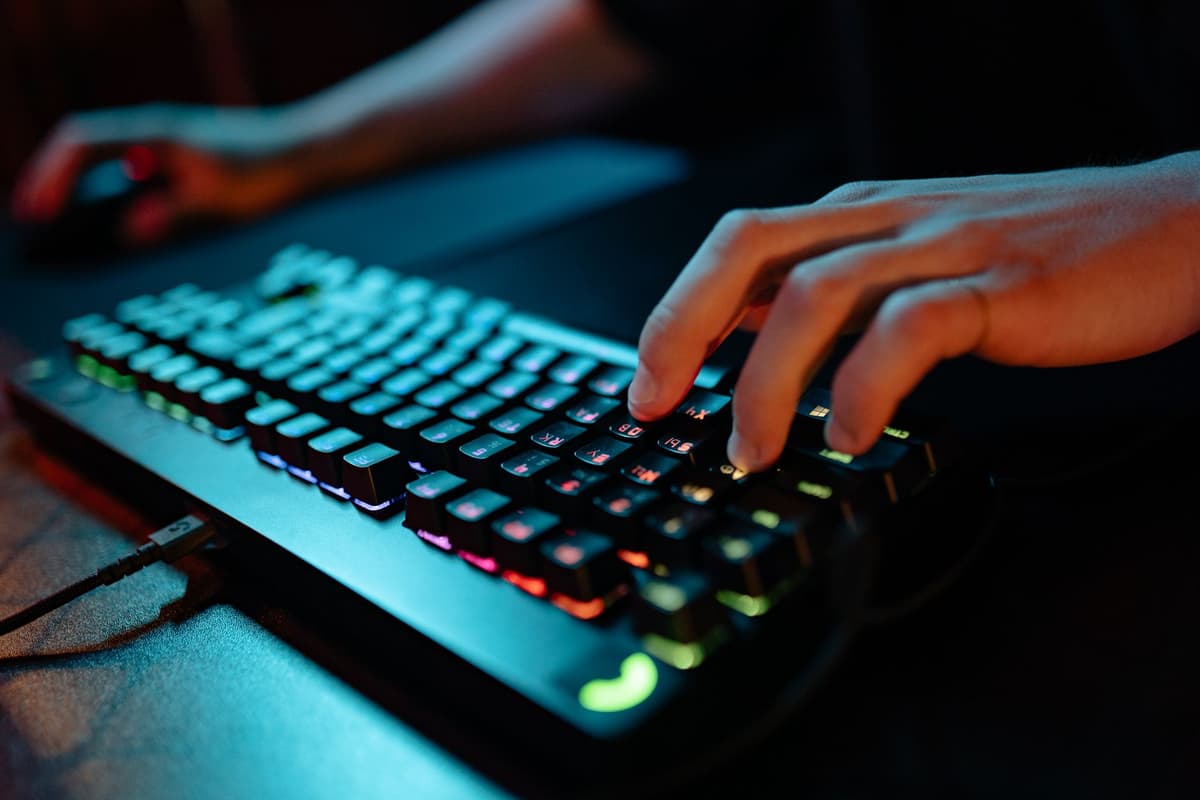
Photo by Yan Krukau on Pexels
Researchers call this 'pre-reflective decision-making,' which is academic Latin for the brain decided what to do three days before the eyes saw it happen. Elite players aren't staring at their units. Eye-tracking rigs revealed that their gaze flickers across three different zones of the monitor while their fingers perform localized surgery on an entirely unseen fourth quadrant based purely on peripheral telemetry and auditory cues. If a normal brain is an office clerk methodically opening envelopes, an RTS pro's central nervous system is a feral cat tossed into a dryer, surviving purely on frantic, mathematically optimal spinal spasms.
Bypassing the Frontal Lobe Entirely
For years, Silicon Valley pitched us the narrative that silicon-based chips would inevitably leave meat-based computers in the dust when it came to rapid micro-evaluations. Tech evangelists loved pointing out that an algorithm can evaluate thousands of branch states while a human is still blinking the sleep out of their eyes. Then the Brood War Bench arrived and proved that if you traumatize a teenager with twenty-four years of an unpatched, brutally unforgiving 1998 video game engine, their neurobiology will simply sprout an organic graphics card out of sheer spite.
Here is how the game essentially mutates human wetware:
- Sub-cortical reflex hijacking: The conscious brain is evicted from the loop. The signal runs straight from the retina to the motor cortex, completely bypassing the parts of you that remember your childhood or know who the current president is.
- Temporal compression: Elite players predict unit paths so far ahead of the game's actual frame rate that they frequently issue move commands to empty dirt where an enemy unit won't arrive for another 120 milliseconds.
- Heuristic pruning: While an AI calculates fifty possible outcomes, the meat-brain discards forty-nine of them using unconscious pattern-matching built on 30,000 hours of digital trauma.
We spent billions of dollars building neural nets, only to discover that the ultimate processing engine was already sitting in a basement in Incheon, surviving exclusively on instant ramyeon and blind rage against Siege Tanks.
The Ghost in the Mechanical Keyboard
In one particularly terrifying test recorded during recent trials, researchers disrupted players' visual fields with microscopic millisecond blackouts. A regular person hits a perceptual wall and stumbles like someone walking into a screen door in the dark. The RTS veterans didn't even drop their input velocity. Their hands just kept clattering away on the Cherry MX Blue switches, building supply depots and micro-managing flying alien leeches via pure muscle-memory echolocation.

Photo by Darlene Alderson on Pexels
Scientists previously assumed that high-level strategy required the slow, majestic machinery of the prefrontal cortex—the noble, deliberative organ that separates us from barnacles. The Brood War Bench proves that real-time strategy at its absolute peak doesn't want your prefrontal cortex. It views your humanity as an annoying bottleneck that introduces lag. It runs the entire war out of your brainstem, right next to the ancient, primordial switches that regulate breathing, vomiting, and running away from saber-toothed cats.
There is something profoundly funny about the fact that the next breakthrough in understanding human neuroplasticity didn't come from studying fighter jet pilots pulling nine Gs over the Mojave. It came from watching a guy named Flash split twelve marine infantry units around a digital landmine using an optical mouse that smells slightly of Doritos dust.
What This Actually Means
The Brood War Bench is proof that human neurobiology isn't a fixed, fragile circuit board with hardcoded biological limits. It is a wildly chaotic, horrifyingly adaptable lump of clay that will reshape itself into whatever grotesque shape is required to survive its environment. If that environment happens to be a brutally fast video game designed during the Clinton administration, the human brain will happily rewire its own optic nerves to shave four milliseconds off a tank blast.
We have barely scratched the surface of what biological reflex mapping looks like when humans stop thinking and start operating as meat-based firmware. We spent the last five years worrying that artificial intelligence was going to render our brains completely obsolete, but we forgot to account for our greatest natural advantage: human beings possess an unlimited capacity to get embarrassingly sweaty over computer games until our biology bends the laws of physics out of embarrassment.
Silicon can keep its cold, calculating logic. We have carpal tunnel, a dream, and a central nervous system overclocked by three hundred milligrams of caffeine and sheer digital panic.
Quick Answers
Is this actually real neuroscience or just hype?
It is entirely real, with multiple universities now using high-APM RTS replay files to study sub-conscious visual processing and motor-cortex efficiency.
Can playing StarCraft make me smarter?
No, it will not help you do your taxes or remember your anniversary, but it will make you terrifyingly fast at closing pop-up browser tabs without looking.
Why StarCraft: Brood War instead of modern games?
Modern games have quality-of-life mechanics that automate chores, whereas Brood War was released in 1998 and actively hates the user, forcing the brain to do every agonizing calculation by hand.