For five years, computational biology insisted that shoving protein databases into black-box neural nets and praying was basically equivalent to understanding nature. Now, mathematicians have arrived to inform everyone that differential geometry exists, and Silicon Valley is acting like it personally invented Riemannian manifolds. It must be exhausting to revolutionize science twice a week just by rediscovering twentieth-century math.
The Advisory Group on Mathematics and Artificial Intelligence just dropped its latest grand dispatch, heralding the "Geometry of Healing." The core revelation? Instead of letting a deep learning model hallucinate an answer and shrugging when asked why a single amino acid substitution causes a cancer drug to fail, we might want to actually map the underlying topological manifold of protein shapes. Groundbreaking stuff. Truly.
The Magic 8-Ball Era of Drug Discovery
Until roughly five minutes ago, the gold standard of AI-driven structural biology functioned like an absurdly expensive lottery machine. You fed billions of parameters into an architecture, burned several megawatts of power, and AlphaFold or ESMFold spat out a ribbon diagram that looked astonishingly pretty in a PowerPoint presentation.
Everyone celebrated. Venture capital funds poured $34 billion into AI biotech startups between 2021 and 2023 alone, because who needs mechanistic explanations when you have a 3D graphic that rotates smoothly on an iPad? If the model predicted that a molecule bound to a receptor, you took its word for it. When the compound failed phase I clinical trials three years and forty million dollars later, everyone blamed the mysterious complexity of human biology rather than the statistical parlor trick running the simulation.
The fundamental defect was simple: black-box transformers do not know what physics is. They are phenomenal correlation engines. They know that sequence A usually looks like shape B because they memorized the Protein Data Bank. But when an oncologist asks why a patient with a single point mutation in their EGFR kinase stops responding to osimertinib, the transformer offers all the explanatory power of a shrugged pair of shoulders.
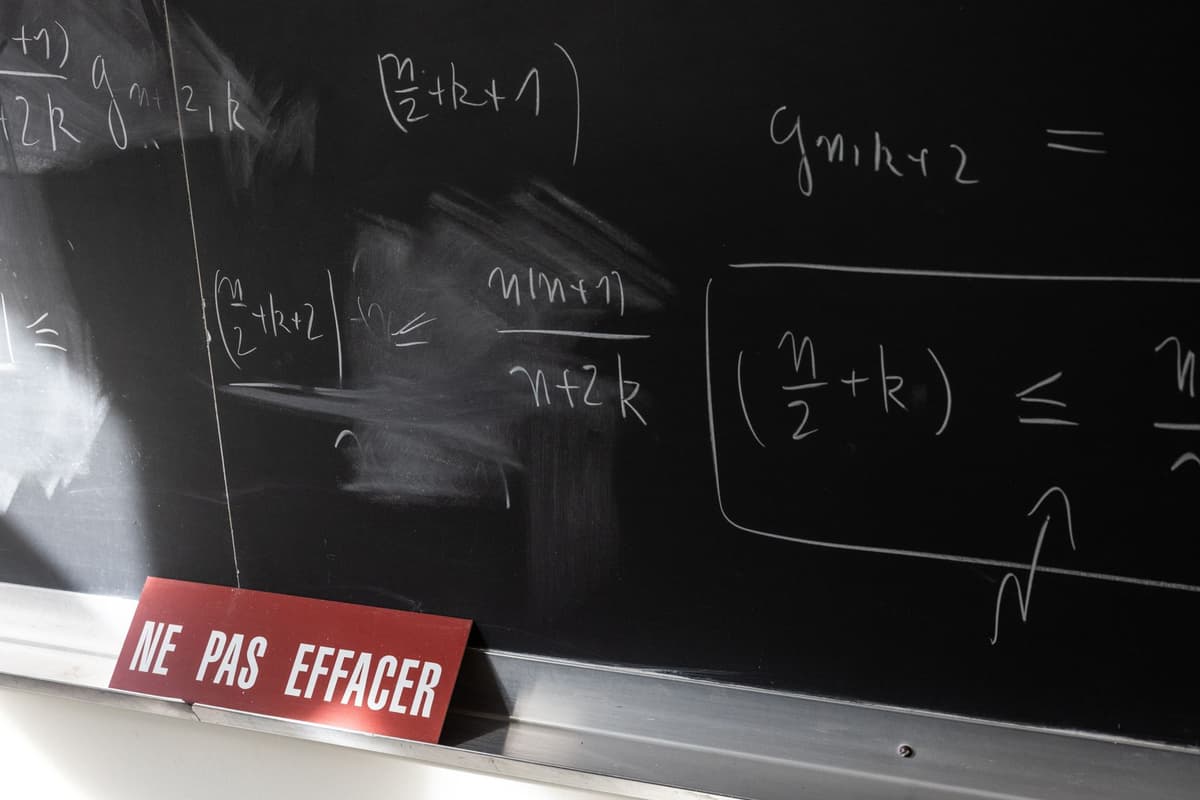
Photo by Jean-Rene Chazottes on Pexels
Mathematicians Step In to Turn on the Lights
The Advisory Group's new framework attempts something radical: doing actual math instead of brute-force curve fitting. By treating protein folding not as a static snapshot but as a dynamic manifold—a continuous, curved mathematical surface representing every valid conformation an amino acid chain can physically twist into—the new models can trace the exact trajectory of a shape change.
Instead of guessing where a protein lands, these models calculate the geometric constraints that dictate how it gets there. It turns out that when you respect symmetry groups and differential forms, you do not need eighty billion parameters to realize that two atoms cannot occupy the exact same coordinate in space. Who could have seen that coming?
- The old way: Train a model on 200,000 known protein crystal structures, feed it a mutated variant, and get a static render that ignores kinetic energy.
- The new way: Map the continuous manifold of potential shapes, revealing the energetic valleys where a mutated protein actually gets stuck.
- The result: You can see whether a drug slips out of a binding pocket before ordering a single vial of chemical reagents.
It is genuinely impressive work, even if it feels like watching someone celebrate the invention of the wheel after years of trying to transport cargo on grease-covered sleds.
The Petri Dish Industry Is Devastated
The real punchline here is aimed squarely at the high-throughput screening industry. For decades, the standard pharmaceutical operating procedure has been breathtakingly blunt: synthesize ten thousand chemical variants, dump them into plastic wells using an acoustic liquid handler, and see which ones turn blue. It was industrialized flailing disguised as rigorous empirical research.
Now, by constraining AI predictions to the actual geometric laws of physical manifolds, researchers can simulate the precise conformational ripple effect of a single mutation in silicon. If an alanine swaps for a valine at position 312, the manifold warps. You can measure the strain tensor. You can predict drug affinity drop-off before anyone washes an Erlenmeyer flask.
Naturally, the press releases are framing this as AI's triumph over human limitations. In reality, it is a rescue mission conducted by pure mathematicians who finally got tired of watching computer scientists treat differential geometry like forbidden dark magic.
What This Actually Means
Strip away the breathless marketing jargon about "healing geometry" and you are left with an overdue paradigm shift: brute-force compute has hit its ceiling. Throwing more GPUs at biological problems without understanding the mathematical symmetries governing those systems was always an intellectual dead end. It just happened to be an exceptionally lucrative one for chip manufacturers.
We are finally transitioning from purely empirical AI—which can mimic biological structures without understanding their rules—to structural models that can't cheat their own math. That matters, because biology does not negotiate with statistical probabilities. A cancer cell does not care that your model had a 96% confidence score; if the steric hindrance is wrong, the drug bounces off.
If this geometric approach holds up across complex, multi-protein complexes, we might finally stop wasting billions of dollars chasing digital hallucinations into clinical graveyards. We will have built something genuinely useful: an AI that knows what it is talking about, simply because we forced it to learn the math first.
Quick Answers
What is a protein manifold in plain English?
It is a mathematical surface that represents all the possible shapes a protein can naturally twist into without breaking its chemical bonds. Instead of viewing a protein as a rigid statue, the manifold treats it as a flexible landscape of movement.
Why couldn't previous AI models predict mutation effects accurately?
Older models were essentially glorified pattern matchers trained on static, healthy protein shapes. They couldn't reliably calculate how tiny, unseen physical changes—like swapping a single amino acid—distort the energy dynamics of the entire structure.
Does this mean lab testing is obsolete?
Not yet. It just means pharmaceutical companies can stop testing thousands of hopeless candidate molecules on plastic trays, narrowing the search down to the handful that mathematically have to work before touching biological matter.