Looking at 526,000 tracked asteroids plotted alongside our swarming low-Earth orbit satellites breaks something fundamental in your intuition. We inherit this cultural myth of the void, this deep-seated belief that once you escape the atmosphere, you are essentially swimming in infinite nothingness. Then you pull up an interactive, real-time map combining planetary defense data with active orbital hardware, and the black background vanishes behind a shimmering blizzard of telemetry.
It makes me wonder how long an illusion can survive after the math disproves it. For decades, mission planners survived on what aerospace engineers informally called the "big sky" theory: space is huge, your satellite is tiny, and the odds of hitting anything are effectively zero. That working assumption felt reasonable when Sputnik was beeping alone, or even in 1995 when roughly 500 active satellites circled the globe. But as of mid-2024, there are roughly 10,000 operational satellites in orbit, paired with hundreds of thousands of cataloged natural space rocks cutting through the ecliptic plane. The big sky is suddenly full of fast-moving metal and stone.
The Ghost Fleet We Share a Neighborhood With
What fascinates me most about this visualization is the convergence of two completely different time horizons. On one hand, you have asteroids that have followed their cold, gravitational loops for 4.5 billion years. On the other hand, you have an artificial constellation launched two weeks ago on a reusable rocket from Cape Canaveral to deliver high-speed broadband to maritime cargo ships.
They share the exact same physical coordinates, yet they represent entirely different eras of cosmic history. Consider the Near-Earth Objects (NEOs). Astronomers have cataloged more than 34,000 of them so far, ranging from mountain-sized planet-killers to tumbling gravel piles just big enough to blow out windows over Chelyabinsk. When you see them rendered at scale, you realize our planet is not cruising through a vacuum. We are wading through an ancient debris field left behind by a messy solar construction project that never quite finished.
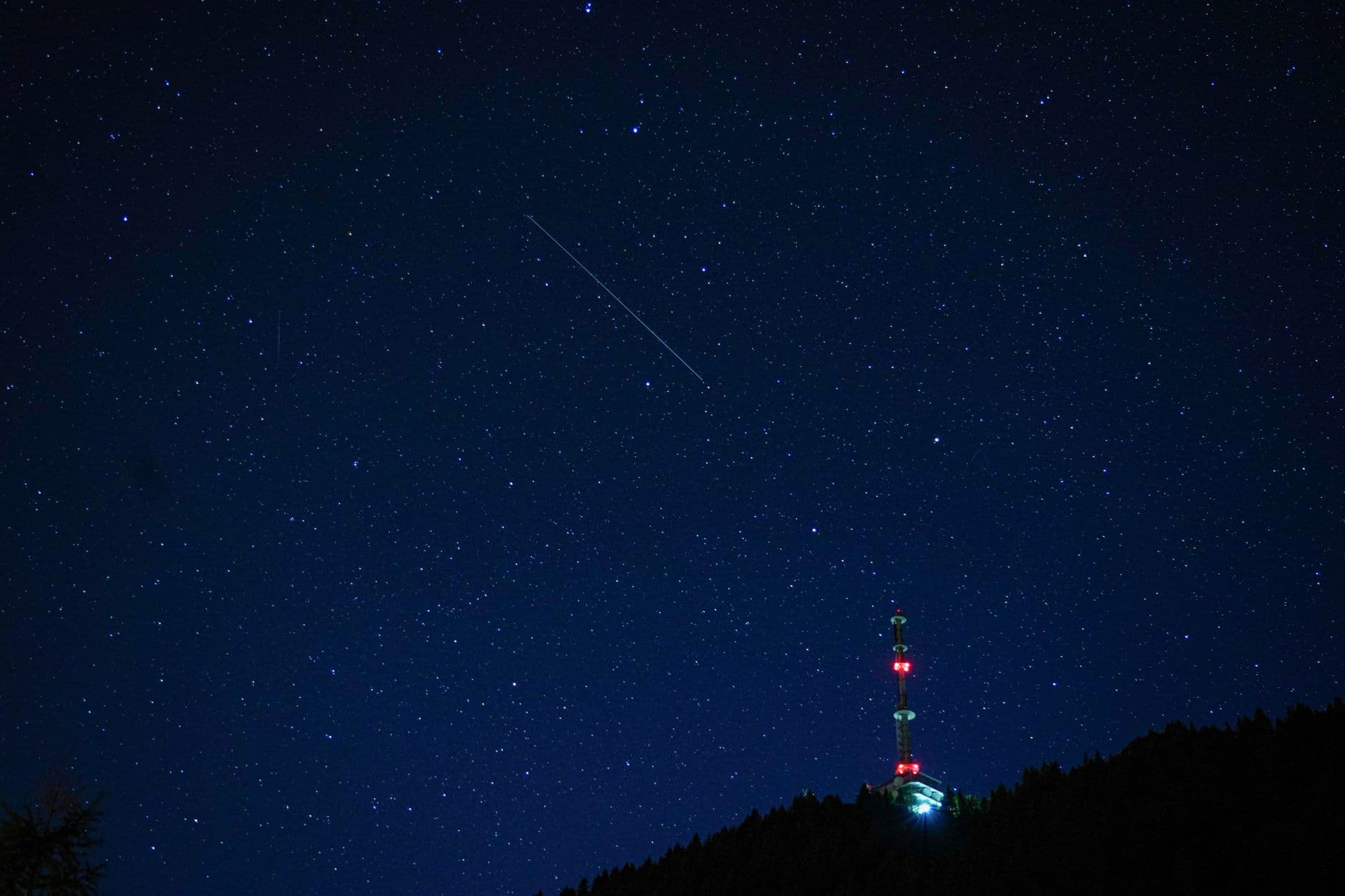
And here is the strange paradox: we know the orbital mechanics of a 500-meter carbonaceous asteroid out past Mars better than we know the real-time intentions of dead rocket boosters tumbling 400 miles above London. Natural asteroids are predictable because nothing touches them except gravity and solar radiation pressure. Satellites, meanwhile, dodge, drift, leak propellant, and sometimes fail without warning.
The Friction Point Where Natural and Artificial Collide
When you track half a million rocks alongside thousands of operational transponders, you realize that orbital carrying capacity is not a theoretical threshold anymore. It is an engineering problem we are actively testing in real time.
To grasp why this feels so precarious, consider what is actually happening in low-Earth orbit (LEO):
- Orbital velocity in LEO sits at roughly 17,500 miles per hour, meaning a collision with a five-millimeter fleck of paint carries the kinetic energy of a dropped bowling ball.
- Private megaconstellations plan to expand the current satellite population toward 50,000 or more within the next decade.
- Automated conjunction warnings, which alert operators that two objects will pass dangerously close, now occur tens of thousands of times every single week.
Think about the cognitive load on the teams watching those screens. If two uncrewed objects have a 1-in-10,000 chance of colliding on Tuesday morning, do you spend precious onboard propellant to maneuver out of the way? If you burn fuel, you shorten the satellite's operational lifespan and burn money. If you do nothing, you roll the dice on creating a debris cloud that could render that entire orbital shell hostile for centuries.
It feels a lot like maritime shipping in the 16th century, right when harbors stopped being open frontiers and started needing lighthouses, harbor masters, and shared rules of the road. We are building the lighthouses while the ships are already crashing into the docks.
Can an Open Void Have an Ecological Limit?
I find myself questioning what word we should even use for this space. We call it "the environment," but we usually reserve that term for things with trees and moss and nitrogen cycles. Yet low-Earth orbit exhibits the classic markers of a fragile ecosystem under sudden pressure.
Ecologists talk about carrying capacity: the maximum population size that an environment can sustain indefinitely without degrading the underlying habitat. Orbit has an invisible carrying capacity dictated by geometry, closing velocities, and atmospheric drag. The higher you go, the longer debris stays trapped. At 300 kilometers, atmospheric friction pulls dead junk down to burn up in months. At 800 kilometers, an aluminum bolt stays in orbit for centuries, circling the Earth sixteen times a day like a ghost that refuses to leave.
If we clutter those altitudes beyond a critical tipping point, we effectively lock ourselves on the surface. That is the haunting edge of this data visualization. It shows us our path outward, but it also outlines the exact cage we could accidentally build around ourselves if we treat orbital altitude like an infinite dumping ground.
What This Actually Means
The real revelation here is not that outer space is crowded, but that our definition of "wilderness" has to adapt to three dimensions. When you watch half a million asteroids and thousands of satellites drifting together across a dark screen, the border between Earth and the cosmos dissolves. Low-Earth orbit is not deep space; it is simply the topmost, thinnest layer of our own planetary infrastructure.
We spent the 20th century looking up at the night sky as a theater of pure observation, a quiet canvas where nothing moved except the slow rotation of stars. That canvas is permanently gone. It has been replaced by a dynamic, high-stakes transit corridor that requires the same continuous stewardship, traffic laws, and humility we failed to apply to our oceans during the industrial revolution.
Perhaps the map is not a warning of catastrophe so much as an invitation to mature. We cannot treat the void as an escape hatch from physical consequences anymore. The sky is finally talking back to us, and it is asking who is going to direct traffic.
Quick Answers
Are these 526,000 asteroids at risk of hitting our satellites?
Extremely rarely, because the vast majority orbit far away in the main asteroid belt between Mars and Jupiter. The map plots them alongside satellites to contrast our natural cosmic neighborhood with our rapidly growing local orbital density.
What is the 'big sky' theory in spaceflight?
It is the outdated concept that orbital space is so vast that the probability of two objects colliding is negligible, meaning active coordination between operators is unnecessary.
How does space situational awareness actually work?
Ground-based radar, optical telescopes, and orbital sensors continuously track objects larger than a softball, calculating their trajectories to warn satellite operators of potential collisions days in advance.