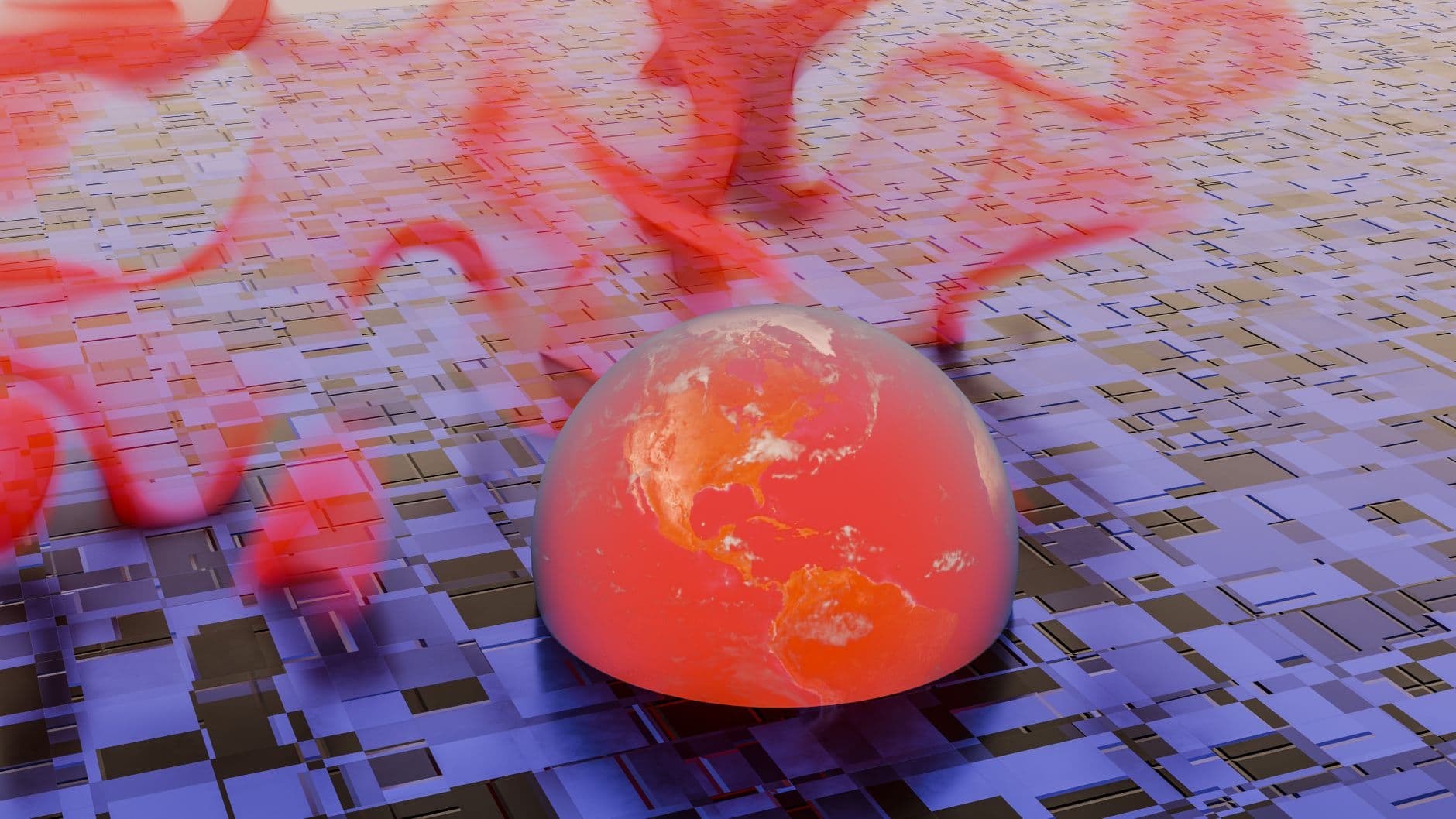
Physicists keep doing this thing where they take my perfectly good Tuesday and ruin it with advanced geometry. The latest consensus from the chalk-dust trenches is that gravity is a hologram, meaning you, your dog, and your unpaid parking tickets are actually smeared across the distant two-dimensional boundary of the universe like crunchy peanut butter on stale toast. We aren't living in a vast, majestic cathedral of space. We are living inside an cosmic LaserDisc that got scuffed in 1997.
Every time theoretical physicists run out of tiny subatomic particles to smash together at the Large Hadron Collider, they pivot to something that sounds like a dorm-room conversation fueled by bad weed and half a bag of Funyuns. This time, the idea is the Holographic Principle, and it is aggressively committed to proving that depth is a scam invented by Big Space.
The Day Depth Got Laid Off
To understand why brilliant people with PhDs are treating our three-dimensional lives like a cheap parlor trick, you have to look at black holes. Back in 1997, a theoretical physicist named Juan Maldacena dropped a 61-page paper on anti-de Sitter space that basically broke the physics community's collective brain. Maldacena showed mathematically that a five-dimensional universe with gravity can be mathematically equivalent to a four-dimensional universe on its boundary that has zero gravity at all.
Since then, the numbers have only gotten weirder. When you throw a filing cabinet into a black hole, conventional wisdom says the information inside it is lost forever, which makes quantum mechanics cry. But in 1973, Jacob Bekenstein calculated that the maximum entropy—or information capacity—of a black hole is directly proportional to its surface area, not its volume. That is completely deranged. If I pack a moving van, the number of cardboard boxes I can shove inside depends on the interior volume of the truck, not the paint job on the exterior doors.

Photo by Kampus Production on Pexels
Yet the universe insists on the paint job. If all the information about what fell into the abyss is stamped neatly on the 2D surface of the event horizon, it means three dimensions are redundant. They are bonus footage. Nature looked at the budget for rendering reality, saw the rendering costs for a full three dimensions, and whispered, "Let's just fake it with mirrors."
Space-Time Is Just Biological Slime Mold
The newest branch of this cosmic indignity treats the fabric of space-time not as a cold, geometric grid designed by Isaac Newton, but as an adaptive, biological-style network. Think of it less like a velvet pool table and more like fungal mycelium weaving through damp mulch under an abandoned shed.
Under this model, space isn't empty stagecraft. It is an emergent property spun out of quantum entanglement, the same way wetness isn't a property of a single H2O molecule, but happens when you get a trillion of them together. Space-time is basically the communal sweat of microscopic quantum bits trying to talk to each other across a room.
- Dimension 1: A single point panicking.
- Dimension 2: The surface of a cosmic balloon where your entire life history is etched as raw code.
- Dimension 3: The glorified pop-up book you currently think you occupy.
- Gravity: Not even a real force, just a rendering artifact caused by the code trying not to crash your local reality server.
If space is an emergent data structure, it means that walking to the fridge at 2:00 AM for shredded cheese isn't actually physical transit. It is a data transfer. You are not traversing twelve feet of linoleum; you are an elaborate file decompression event occurring across the perimeter of the observable cosmos. It makes midnight snacking feel much more administrative.
The Utter Audacity of the 2D Boundary
Imagine explaining this to an alien civilization with actual problems. They arrive on Earth in a chrome dreadnought that cost 400 billion space-credits, asking for our greatest scientific achievements, and we hand them a binder that says: "Good news! We proved your ship doesn't have an inside. In fact, you're currently standing on a flat sheet of information thirteen billion light-years behind you."

Photo by cottonbro studio on Pexels
The cosmological implications are wildly disrespectful to everyday human suffering. If my knee hurts when it rains, that's not cartilage wear. That's a rounding error on a boundary membrane located somewhere past the orbit of Pluto. It changes how you look at traffic. You aren't stuck behind a 2004 Honda Civic with an expired registration; you are trapped in an inefficient data packet that the cosmic boundary forgot to clear from its cache.
Physicists are genuinely thrilled about this because it might bridge the century-old divorce between Einstein's general relativity and quantum mechanics. Quantum mechanics hates smooth curves; Einstein hated chunky quantum pixels. The holographic screen gives them a neutral room where they can scream at each other without gravity ruining the furniture. But for the rest of us, it means our entire identity has the structural integrity of a counterfeit holographic Pokémon card.
What This Actually Means
Strip away the terrifying tensor calculus, and the holographic hypothesis is the ultimate humbling. Humanity spent millennia thinking we were the center of the universe, then we grudgingly accepted we were on a damp rock orbiting an ordinary yellow star, and now physics is telling us we aren't even inside the room.
We are peripheral projectionists. Everything you have ever loved, every war ever fought, every terrible haircut from eighth grade—it's all happening on a cosmic movie screen, while the actual film reel is baking on a flat fence at the edge of the dark. Space isn't a theater; it is a trick of the light.
Does it change how you pay your rent tomorrow? Not in the slightest. The landlord's collection software operates on the exact same projected plane of existence as your empty bank account. But the next time you drop your phone face-down on concrete, take comfort in the math: technically, neither the phone nor the pavement actually exists in three dimensions, which makes the shattered screen entirely the fault of the boundary universe's low refresh rate.
Quick Answers
Am I actually living in a simulation like The Matrix?
No, because a simulation implies some greasy teenager in a higher dimension is running you on a computer. The holographic principle is worse: it's just raw, unmanaged nature being embarrassingly cheap with its data storage.
If space is 2D, why can I walk around a lamppost?
Because the information describing you and the lamppost is encoded with specific mathematical relationships that project depth into our perception, exactly like a hologram on a credit card looks 3D when you tilt it under a desk lamp.
Does this mean gravity doesn't exist?
Gravity exists, but it's likely an "emergent" illusion rather than a fundamental ingredient of the cosmos, much like how the music coming out of your headphones isn't an ingredient inside the copper wire.