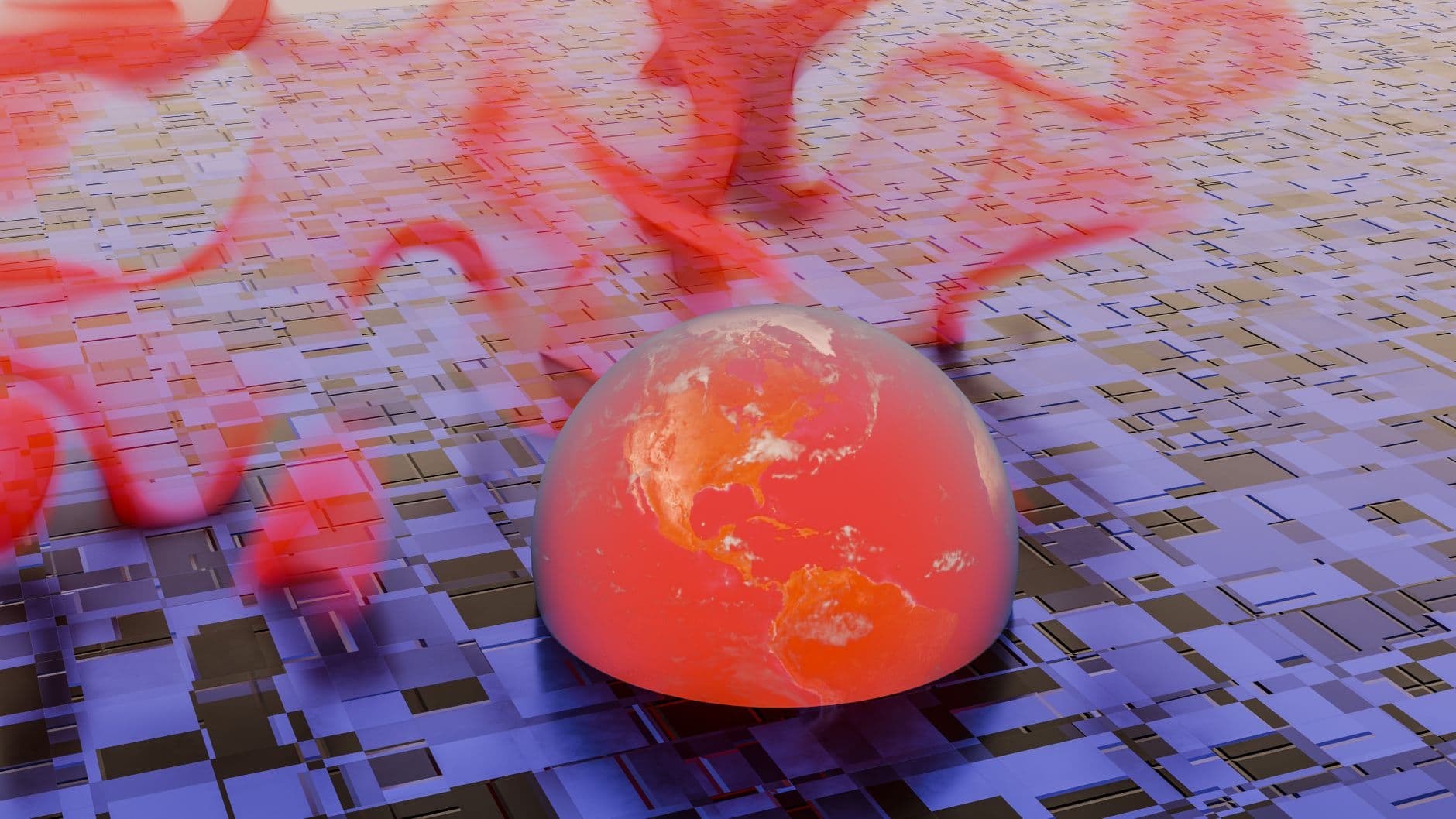
It turns out your back pain, your mortgage, and the entire observable cosmos are just sloppy rendering artifacts from a boundary sheet at the edge of the universe. Theoretical physics has finally achieved peak efficiency: proving that nothing actually exists and charging taxpayers billions of dollars to explain it.
For nearly a century, brilliant people in chalk-covered sweaters insisted that if we just smashed atoms hard enough inside an underground donut in Switzerland, the universe would cough up its secrets. Instead, the mathematics of quantum gravity has arrived at a much more humbling punchline. We do not live in a majestic three-dimensional cathedral of matter and motion. We live on the physical equivalent of a credit card hologram that looks vaguely like an eagle if you tilt it under a desk lamp.
The Ultimate Downsizing Exercise
The premise of the holographic principle, which started with Juan Maldacena's 1997 anti-de Sitter/conformal field theory correspondence, is deceptively simple. Take all the physics inside a three-dimensional volume, complete with the messy, inconvenient nuisance known as gravity. Now, write down a purely two-dimensional quantum system on the boundary of that space, without any gravity whatsoever.
Mathematically, the two descriptions are identical. Not similar. Not poetic metaphors for each other. Identical.
The immediate consequence of this breakthrough is that gravity isn't a fundamental force at all. It is an emergent bookkeeping error. It is what happens when quantum entanglement on a cosmic perimeter gets tangled up and projects an illusion of depth inward. If you drop your coffee mug on the floor tomorrow morning, do not blame Isaac Newton or Albert Einstein. Blame a cluster of qubits on a hypothetical horizon infinitely far away that couldn't be bothered to maintain spatial coherence.

Photo by Lucas Andrade on Pexels
Naturally, the latest iterations of this theory take the joke a step further. Instead of just treating the universe as a hard drive, theorists are now floating models where spacetime behaves like an adaptive, self-organizing data network. Spacetime as biology. Because if there is one thing theoretical physics desperately needed, it was to import the notoriously reliable precision of evolutionary metaphors to describe quantum states.
A Century of Smashing Rocks Together
Consider the sheer historical comedy of how we got here. In 2012, humanity spent roughly $4.75 billion to discover the Higgs boson at CERN, an extraordinary triumph that completed the Standard Model and promptly answered zero of the questions keeping cosmologists awake at night.
We wanted a tidy synthesis. We wanted general relativity, which treats space as a smooth, heavy fabric, to shake hands with quantum mechanics, which treats reality as a twitchy casino of discrete packets. Instead of a handshake, we got a legal notice informing us that the fabric doesn't exist.
Here is how theoretical physics traditionally solves its crises:
- Build an impossibly expensive machine to find a hypothetical particle.
- Fail to find the supersymmetric partners that were supposed to save the math.
- Declare that particles were a primitive concept anyway.
- Move the goalposts to a 2D surface located at spatial infinity where nobody can run an experiment to check your work.
It is an undeniably brilliant career strategy. You cannot be contradicted by empirical data if your theory relies on string theory scales occurring at the Planck length, a cozy 1.6 x 10^-35 meters, where experimental verification would require a particle collider roughly the size of the Milky Way.
Spacetime as Cosmic Bloatware
The newest theoretical papers suggest that spacetime is less like a solid stage and more like the user interface of an operating system. You see a desktop icon of a folder. You drag it to the trash. There is no tiny physical folder inside your laptop; there are just voltage fluctuations across silicon gates.
According to the cosmic screen crowd, your physical body is the desktop icon. The real action is the raw machine code scrambling around on a distant boundary screen.

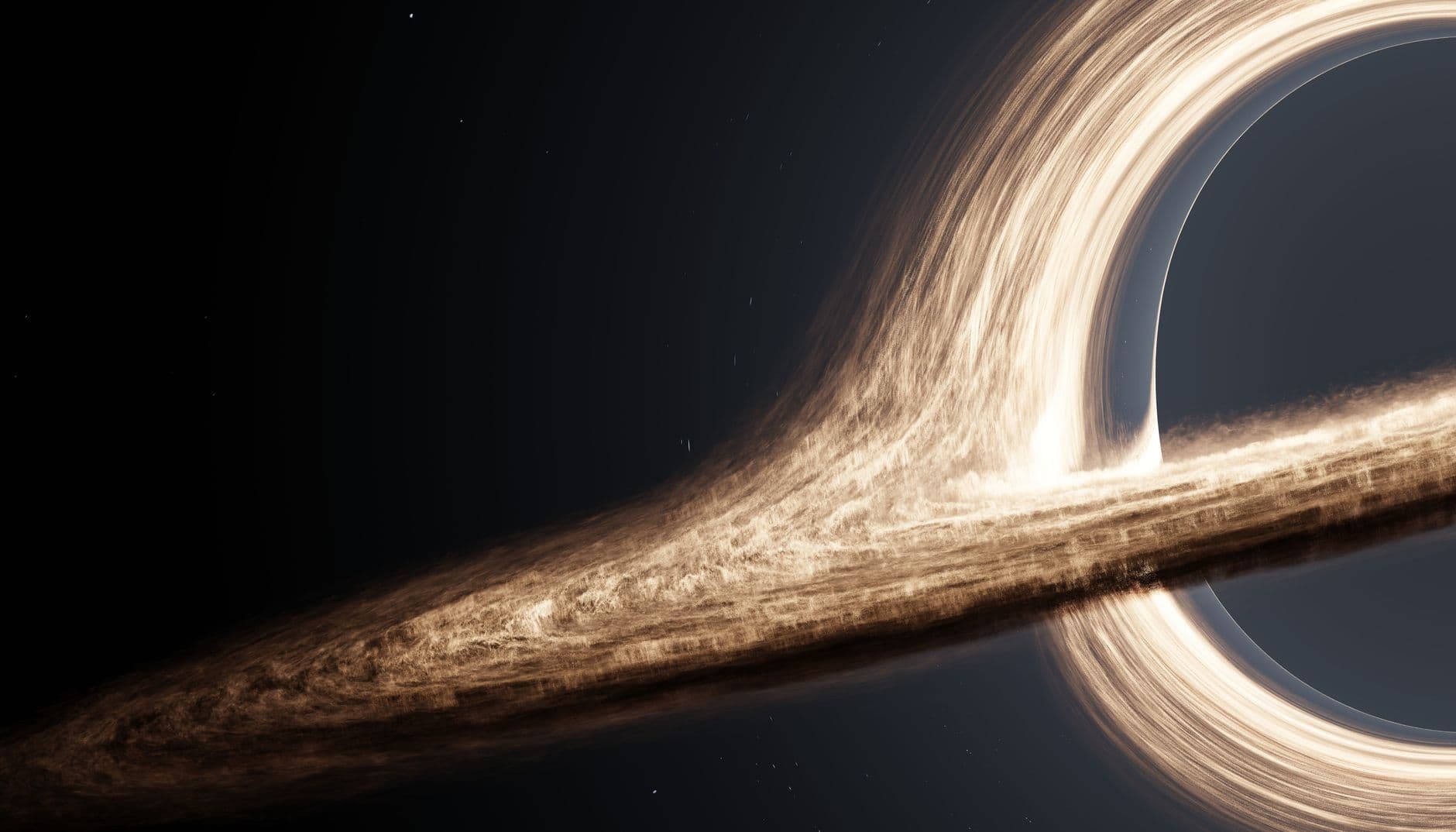
Photo by Daniil Komov on Pexels
This reframing solves the black hole information paradox, which is great news for Stephen Hawking's legacy and essentially useless for everyone else. If information falling into a black hole is preserved on its two-dimensional event horizon rather than destroyed in the singularity, the laws of quantum mechanics remain unbroken. All it cost us was the objective reality of physical depth. It is comforting to know that while your flight was delayed four hours on the tarmac, the bits representing your frustration were meticulously preserved on a two-dimensional shell at the edge of the universe without loss of entropy.
Physicists are currently patting themselves on the back for concluding that the universe is basically an organic, self-correcting error code. We went from theclockwork universe of the Enlightenment, to the thermodynamic engine of the Industrial Revolution, to the computational matrix of the Silicon Age, and now to an auto-poetic data organism. Science has a charming habit of looking out into the cosmos and discovering whatever gadget or philosophy happens to be trending in the faculty lounge that decade.
What This Actually Means
Strip away the breathtaking mathematical architecture, and the holographic principle is theoretical physics throwing its hands up. It is the formal admission that trying to understand our physical world by looking at the things inside it is fundamentally a sucker's game.
If the universe is indeed a projection, it means our centuries-old intuition about cause, effect, locality, and distance is merely a cheap sensory shortcut. Distance is an illusion manufactured by quantum entanglement. Two particles are not talking to each other faster than light across billions of light-years; they were never separated to begin with on the boundary surface where the math actually lives.
You are not a protagonist moving through three-dimensional space. You are a shadow puppet on the wall of a cave, except Plato didn't realize the puppet master was a tensor network running an unoptimized script. Sleep well tonight knowing that whatever poor decisions you make this week, they were pre-rendered on a flat surface somewhere else entirely.
Quick Answers
Does this mean we live in a computer simulation?
No. The holographic principle is about the mathematical degrees of freedom required to describe reality, not an alien teenager playing a cosmic version of The Sims on a laptop.
Can I physically touch this 2D boundary screen?
No, because you are part of the projection inside it. A character in a video game cannot reach out of the screen to tap the HDMI cable.
If gravity isn't real, why do things fall down?
Because the underlying quantum entanglement on the boundary organizes itself in a way that generates the geometric curvature we call gravity. The effect is entirely real to you, even if the mechanism is an emergent illusion.