It turns out the apex of human computational achievement is entirely powerless against lukewarm pancake batter. We built a machine that writes passable sonnets and aces standardized tests designed for anxious undergraduates, but a five-ton vat of industrial mayonnaise still reduces our most sophisticated predictive models to digital confetti. Silicon Valley promised us artificial general intelligence by next Tuesday; instead, we are being humbled by high-fructose corn syrup.
Every tech evangelist with an internet connection loves telling factory owners that physical reality is simply an optimization problem waiting for enough compute. Then the venture capitalists walk onto a food processing floor, look at a planetary mixer churning through three thousand pounds of viscoelastic rye dough, and confidently announce that an enterprise LLM can streamline the batch cycle. The dough does not care about the prompt engineering. The dough obeys non-linear partial differential equations that humanity has spent nearly two centuries failing to solve analytically.
The Navier-Stokes Wall of Humiliation
If you want to watch a room full of data scientists age a decade in forty-five minutes, hand them a pump feeding molten chocolate into an industrial enrober. Chocolate is a non-Newtonian, thixotropic fluid. That means its viscosity changes depending on how hard you shear it, how long you stir it, and whether a truck drove past the loading dock twenty minutes ago.

Photo by Andres Ayrton on Pexels
At the core of this failure lies the Navier-Stokes equations, drafted back in the 1840s. These equations describe how fluids move. In theory, they describe everything from airflow over an F-35 wing to the swirling milk in your morning latte. In practice, finding smooth, general solutions for them in turbulent regimes is so famously impossible that the Clay Mathematics Institute put a $1,000,000 bounty on it in May 2000. That prize money is still sitting in the bank, untouched, mocking us.
When a fluid enters turbulence, the number of interacting variables scales exponentially. You cannot just approximate the system by feeding four hundred years of culinary patents into an autoregressive transformer. The LLM guesses the next token based on statistical patterns; the fluid transfers momentum across micro-vortices in a chaotic cascade where a microscopic temperature delta at step twelve breaks the entire emulsion at step eighty. You do not get an intelligent synthesis. You get twenty thousand dollars of broken fat and water separation that smells vaguely of defeat.
Why Text Models Choke on Tomato Paste
There is a peculiar modern hubris that treats physical manufacturing like software development without the git commits. Venture capital injected over $14 billion into food-tech startups between 2021 and 2023, largely predicated on the fantasy that industrial food processing was merely an inefficient legacy pipeline waiting for a dashboard.
Here is what happens when you try to replace physical factory floor telemetry with generative or statistical models:
- The model assumes consistent batch homogeneity, which exists only in physics textbooks and slide decks.
- A 0.4% swing in raw wheat protein content alters gluten network development, rendering the model's torque predictions useless within four minutes.
- The mixer's internal wall temperature drifts by two degrees Celsius, transforming what was supposed to be a smooth laminar flow into a violent shear event that clogs a $250,000 valve.
- The model confidently outputs that the batch is ready, right up until the slurry solidifies into industrial grout inside the stainless-steel piping.
Language models work brilliantly in abstract semantic spaces because words do not exert drag. Words do not experience yield stress. If an AI hallucinates a legal precedent, it gets an angry memo from a judge. If an automated process controller hallucinates the flow rate of industrial tomato paste, the back-pressure ruptures a flange and paints three industrial hygienists red.
The Glorious Return of Dave the Tank Whacker
After six months of failed digital transformation pilots, multi-million-dollar food conglomerates quietly complete the same humiliating ritual. They mothball the digital twin dashboard. They turn off the predictive neural net. Then they walk into the breakroom and beg Dave to come out of semi-retirement.
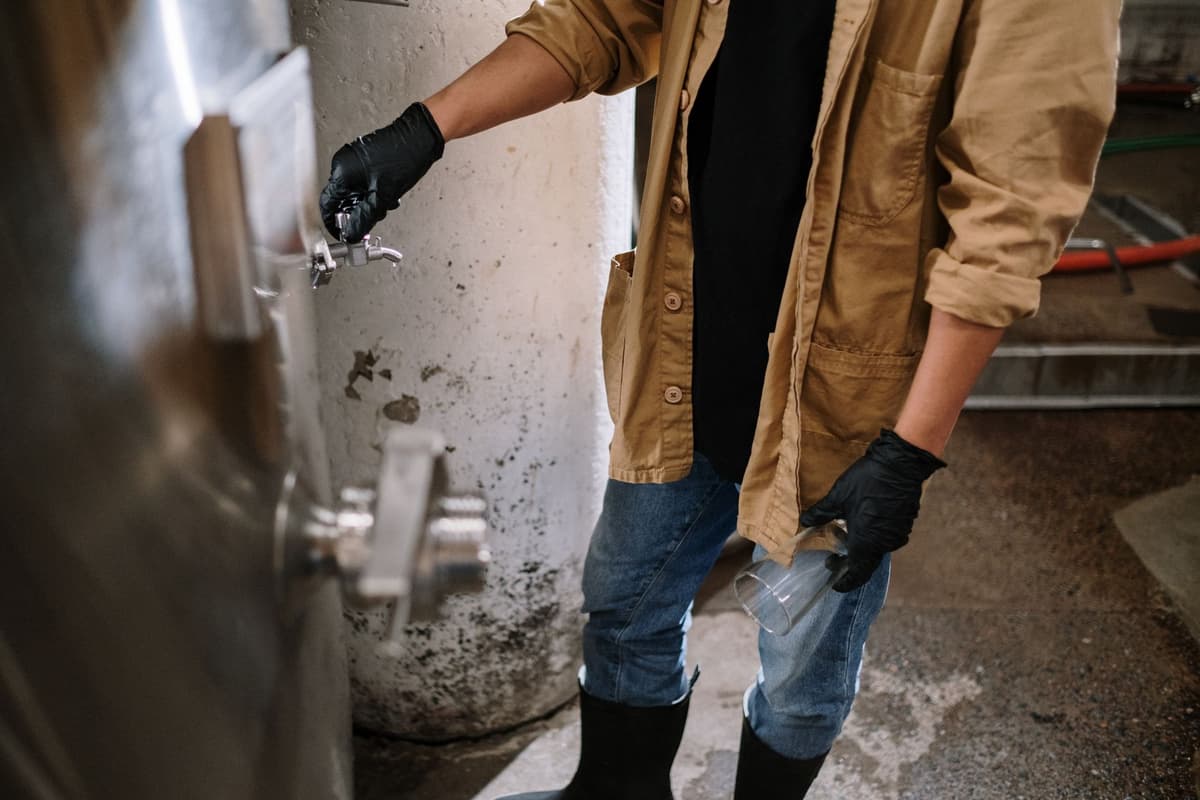
Photo by cottonbro studio on Pexels
Dave does not possess a computer science degree. Dave possesses a small brass wrench and thirty-four years of sensory scar tissue. Dave walks up to an eight-thousand-gallon stainless-steel tank, strikes the side of it twice, listens to the resonance, rubs a drop of slurry between his calloused index finger and thumb, and says, "It's too tight. Needs another three gallons of water and four more minutes on the slow paddle."
Dave is right 100% of the time. The billion-dollar tech stack was right 61% of the time, which, in industrial operations, is worse than flipping a coin because flipping a coin does not require a cloud computing subscription. Dave is using real-time, multi-modal biological sensors calibrated over millions of seconds of ground-truth physical feedback. He is measuring surface tension, viscoelastic recoil, and acoustic resonance through his knuckles. We tried to automate him out of the payroll, and instead, we proved that his nervous system remains the only machine capable of surviving contact with whipped egg whites.
What This Actually Means
The gap between symbolic intelligence and mechanical reality is not a crack you can pave over with more H100 GPUs. We are running headfirst into the hard thermodynamic limits of the physical universe, where non-linear dynamics laugh at statistical inference. It is easy to be bullish on software when your product lives in a sandbox where errors just throw an unhandled exception.
Industrial food production exposes the vanity of the current technology cycle because you cannot prompt-inject a vat of caramel. You cannot hallucinate viscosity. When the equations of fluid motion refuse to yield to closed-form solutions, your computational shortcuts don't produce emergent reasoning; they produce a burnt sugar crust that requires eight hours of high-pressure caustic washing to scrape off the heat exchanger.
Until a neural network can resolve the Kolmogorov microscales of a churning industrial slurry, the master of the factory floor will remain the person who knows what the tank sounds like when it is angry. Silicon Valley wanted to build a god. For now, it cannot even reliably pump the cheese sauce.
Quick Answers
Why can't artificial intelligence just simulate fluid flow accurately?
AI models excel at pattern recognition, but turbulent fluid dynamics involve non-linear interactions across vast scales of space and time. Even supercomputers running pure physics engines struggle with full Navier-Stokes simulation without massive approximations, and statistical models simply compound those errors over time.
Why are food products harder to model than water or air?
Water and air are simple Newtonian fluids with constant viscosity. Industrial food slurries—like batter, chocolate, and sauces—are non-Newtonian mixtures whose thickness, elasticity, and flow change radically based on shear rate, temperature, and physical agitation.
Can't we just use reinforcement learning to manage factory mixing?
Reinforcement learning requires millions of trial-and-error iterations to learn an environment. In the physical world, running fifty thousand failed batches to train an agent translates into millions of dollars in destroyed raw materials and permanently damaged industrial equipment.


