
Your Architect Is a High School Dropout
Forget the Bauhaus. Forget Le Corbusier. The most influential designer of the modern era isn't some turtleneck-wearing visionary with a drawing board; it’s the guy who realized that if you fold a piece of corrugated cardboard just right, it can withstand the weight of three other identical pieces of cardboard without crushing a Hawaiian thin-crust. We have reached the pinnacle of human achievement where the 'Pizza Box Project Stack'—a literal attempt to standardize non-pizza logistics around the dimensions of a 14-inch square—is being treated as a breakthrough in urban modularity.
It turns out that building codes and zoning laws are just cute suggestions compared to the uncompromising physical reality of a delivery driver's backseat. We aren't building cities for people anymore. We aren't even building them for cars. We are building them for the precise, grease-resistant dimensions of the B-flute corrugated container. If it doesn't fit in the stack, it doesn't exist in the modern economy.
The Cardboard-Defined Reality
The sheer audacity of the 'Stack' project is almost admirable in its nihilism. It acknowledges that because we have spent the last decade optimized for the 'last-mile' delivery of junk food, the most efficient way to move medicine, electronics, or human organs is to disguise them as a Meat Lover’s special. Why redesign the world when you can just make the world fit into a box that was originally designed to keep a crust from getting soggy in 2012?
- The 12-to-16-inch square is the new metric system.
- Sidewalk widths are no longer calculated by pedestrian flow but by the turning radius of a delivery bot carrying six stacks.
- Elevator wait times are optimized for the thermal decay of mozzarella.
- Apartment lobbies are now just glorified mailrooms with a few decorative plants to hide the shame of our dependency.
We used to talk about 'human-centric design.' Now, we talk about 'logistical throughput.' It’s a beautiful transition, really. Instead of designing a city where you can walk to a store, we’ve designed a city where the store is a fleet of e-bikes carrying identical white squares. It’s modular. It’s scalable. It’s incredibly depressing if you think about it for more than four seconds.
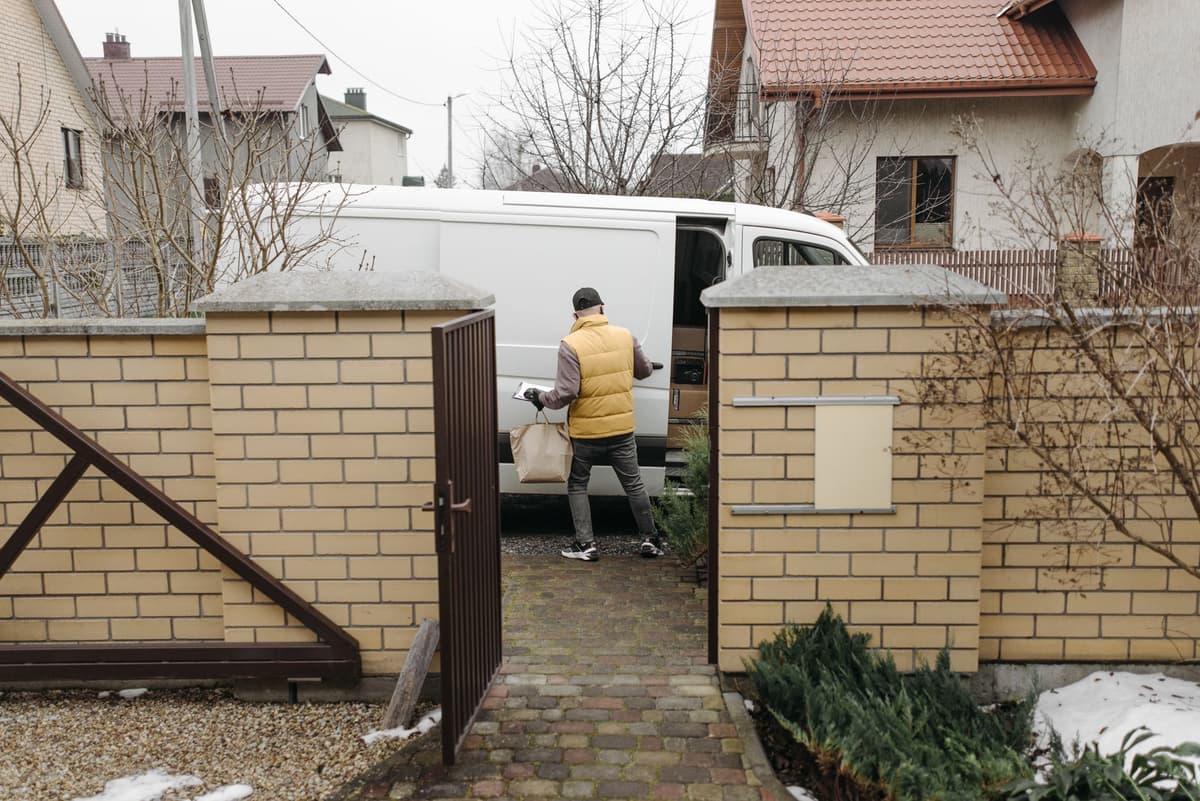
Photo by Pavel Danilyuk on Pexels
Sovereignty of the Hot Bag
The 'last-mile' problem used to be a challenge for engineers. Now, it’s a lifestyle. The geometry of the delivery vehicle—the moped rack, the insulated backpack, the autonomous rover—is the new primary architect of the urban environment. If a building doesn't have a dedicated 'staging area' for the Stack, it is effectively a relic of the Victorian era. We are retrofitting 100-year-old brownstones not to be more energy-efficient, but to ensure a courier can drop a stack of cardboard without having to find a parking spot.
There is something deeply poetic about the fact that our most advanced logistical AI is currently working overtime to solve the 'Pizza Box Stack' problem. We have billions of dollars in venture capital flowing into 'modular logistics,' which is just a fancy way of saying 'making sure the box doesn't slide off the bike.' It is the ultimate triumph of the mundane over the magnificent. Michelangelo had the Sistine Chapel; we have a reinforced cardboard corner that prevents 'box sag.'
What This Actually Means
This isn't just about pizza. It's about the total surrender of urban space to the requirements of the delivery container. The 'Carton-Defined City' is a place where the physical world is increasingly treated as a series of obstacles between a warehouse and a consumer. When we start hacking the dimensions of a pizza box to transport 'non-food items,' we are admitting that the infrastructure of the pizza industry is more robust than the infrastructure of the government.
We have created a world so specialized in the movement of flat, square objects that we are now forced to make everything else flat and square just to survive. It’s the square peg in the square hole, forever. The city of the future isn't a shining metropolis on a hill. It’s a stack of cardboard boxes in a rain-slicked alleyway, waiting for someone to notice that the contents are cold.
If you want to know what your neighborhood will look like in ten years, don't look at the blueprints at City Hall. Go to the dumpster behind a Papa John's and measure the trash. That’s the grid your life is about to be lived on.
Quick Answers
Is the Pizza Box Stack actually a real thing?
Yes, it’s a logistical framework designed to leverage the existing, ubiquitous dimensions of pizza delivery for general e-commerce. Because apparently, we can't invent a second type of box.
Why can't we just use regular mail?
Because the 'last-mile' infrastructure for pizza is faster, more decentralized, and more desperate than the federal government will ever be.
Does this mean my new iPhone will come in a pizza box?
If it saves a logistics company $0.04 in shipping overhead by fitting into a standard stack, then yes, enjoy your grease-scented tech.


