
The Wet Sandwich in Your Head
Your brain is a three-pound lump of electrified meat that is remarkably bad at following instructions. For the last seventy years, our best solution for when the meat gets sad or shaky has been systemic pharmacology—a fancy term for 'swallow this pill and hope it doesn't make your liver explode while it tries to find your hippocampus.' It is an incredibly blunt instrument. Taking a pill for depression is like trying to fix a single broken string on a piano by throwing a bucket of water at the entire orchestra. Sure, you might dampen the noise, but the cellist is now drowning and the conductor is furious.
Karl Deisseroth looked at this situation and decided we needed to stop being so messy. He pioneered optogenetics, a field that sounds like something a Bond villain would use to create an army of hypnotic sharks. The premise is delightfully absurd: we take the light-sensitive proteins found in pond scum (algae, if you want to be posh about it) and use a virus to smuggle the DNA for those proteins into your brain cells. Suddenly, your neurons are light-sensitive. You have essentially turned your brain into a biological Lite-Brite.
Once those neurons are primed, you thread a tiny fiber-optic cable into the brain. Want to stop a Parkinsonian tremor? Click. Blue light on. The specific circuit responsible for the shaking gets told to sit down and shut up. No systemic side effects. No 'may cause dry mouth, night terrors, or a sudden urge to buy a unicycle.' Just a precise, high-speed flick of a switch. We are moving from the era of 'Magic Potions' to the era of 'Precision Engineering for Meat Computers.'
Algae DNA and Your Mid-Life Crisis
There is something fundamentally hilarious about the fact that the secret to curing complex human neurological disorders was sitting in a stagnant pond in 2005. Deisseroth realized that Chlamydomonas reinhardtii (the algae in question) had already solved the hardest problem in neuroscience: how to turn light into an electrical signal. Evolution spent millions of years perfecting a way for pond scum to find the sun, and we’re just out here copy-pasting that code into our prefrontal cortex so we can stop feeling existential dread about our emails.
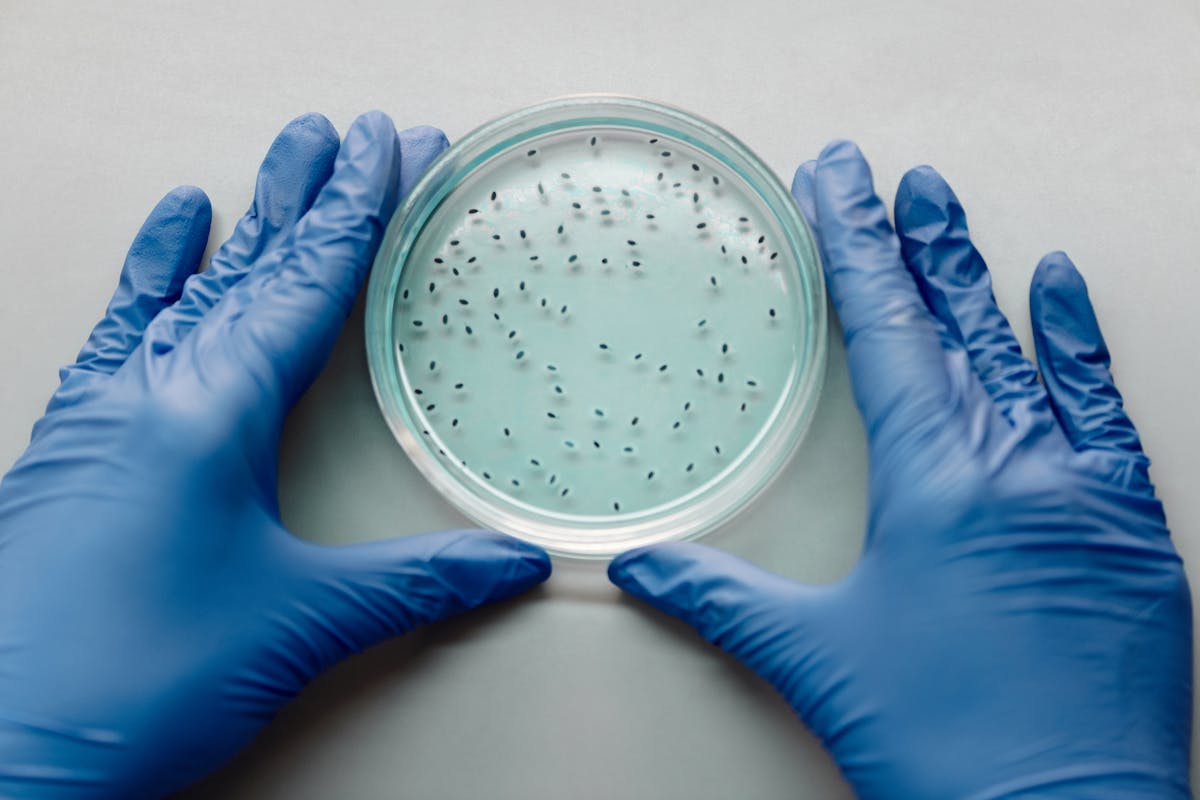
Photo by Edward Jenner on Pexels
This isn't just a lab trick anymore. We’ve moved past making mice run in circles—which, to be fair, is a classic of the genre—and into actual clinical reality. We are talking about targeting the exact sub-set of cells that trigger a binge-eating episode or a PTSD flashback. It’s the difference between carpet-bombing a city and sending in a single, very polite ninja to turn off the oven.
What makes this so funny is the sheer audacity of the hardware. We are literally talking about 'Deep Brain Stimulation 2.0: The Rave Edition.' If you told a doctor in 1950 that in 2024 we’d be curing brain diseases by making cells 'see' light via a wire made of glass, they would have had you lobotomized on the spot. Now, it’s just another Tuesday at Stanford. We’re turning the most complex structure in the known universe into a series of 'If/Then' statements controlled by a laser pointer.
The End of the Chemical Hangover
The real win here is the death of the side effect profile. Traditional drugs are the ultimate 'reply all' email. You want to talk to the dopamine receptors in the reward center? Too bad, the receptors in your gut are also listening, and now you’ve been in the bathroom for forty-five minutes. Optogenetics is the private DM of medicine. It’s a closed-loop system where the light only talks to the cells that have been invited to the party.
Imagine a world where 'taking your meds' involves a quick pulse of 473-nanometer light delivered via a grain-of-sand-sized implant. No more waiting six weeks for the SSRIs to kick in while you wonder if your personality is being replaced by a cardboard cutout. It’s instantaneous. It’s binary. It’s like having a volume knob for your anxiety, and finally, someone is turning it to the left.
Of course, there are hurdles. We have to convince people that 'injecting a virus to change your brain DNA and then sticking a laser in there' is actually a good thing. It’s a tough sell at a dinner party. 'Oh, this? It’s just my algae-powered brain-light. It keeps me from crying during Thai food commercials.' But when the alternative is a lifetime of chemical fog, the 'Light-Switch Brain' starts to look like the most logical thing we’ve ever invented.
What This Actually Means
We are witnessing the transition of psychiatry from a soft science to a hard engineering discipline. For a century, we’ve been guessing. We’ve been talking to the meat, or throwing salt at the meat, or shocking the meat. Karl Deisseroth’s work proves that the brain is a circuit, and if you have the right screwdriver—or in this case, the right beam of light—you can fix the wiring without burning the house down.
This isn't just about Parkinson's or depression; it's a fundamental shift in how we view the human experience. If we can toggle 'courage' or 'satiety' or 'calm' with a fiber-optic cable, we have to reckon with the fact that our most profound emotions are just specific patterns of light-sensitive ions moving across a membrane. It’s a bit demeaning, honestly. I’d like to think my love for artisanal cheese is a soul-level event, but it’s probably just a specific cluster of neurons in the hypothalamus firing at 20 Hertz.
Ultimately, the 'Light-Switch' brain is the ultimate upgrade. We are taking the messy, chaotic biological legacy of our ancestors and installing a user-friendly interface. It’s weird, it involves pond scum, and it’s probably going to save millions of lives. If that isn't worth a little bit of fiber-optic brain-surgery, I don't know what is.
Quick Answers
Will this turn me into a remote-controlled robot?
Only if the person with the remote is you, and even then, it’s less about 'control' and more about 'not having a nervous breakdown in the grocery store.'
Do I have to keep the algae in a tank in my room?
No, we just steal their DNA once and then thank them for their service. The algae stay in the pond; the 'light-sensitive' part stays in your head.
When can I get my brain-laser installed?
Clinical trials are already happening for things like vision restoration, but for general 'mood-switching,' you’re probably looking at a decade of regulatory paperwork and safety checks.

