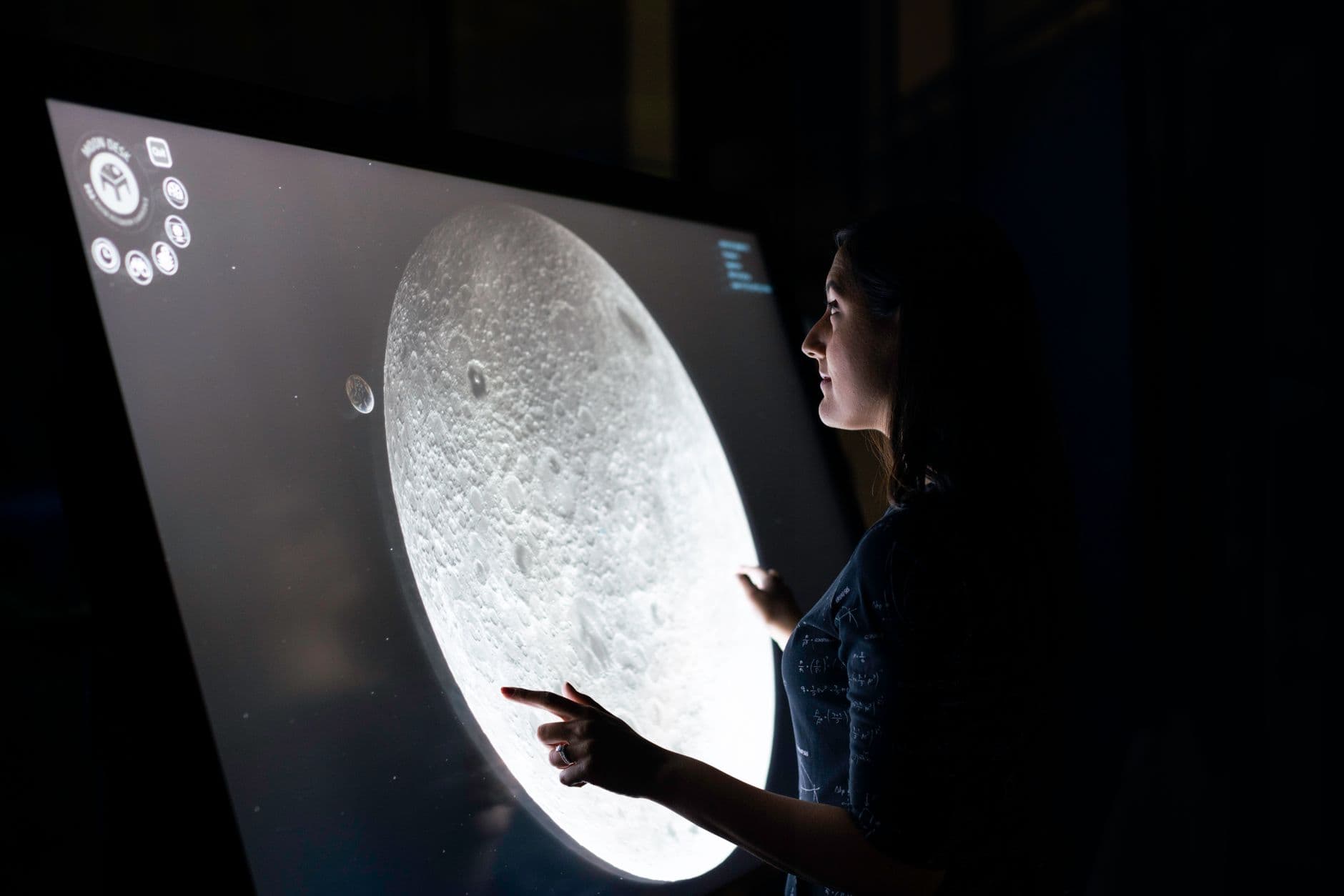
I can't stop thinking about the fact that we’ve spent decades looking at the Moon when we should have been looking through it. For years, the lunar regolith—that fine, gray, annoying dust that gummed up the Apollo gears—was just seen as a geological hurdle. Now, physicists are realizing that this 30-meter-deep layer of dry, silica-rich debris is actually the perfect medium for catching neutrinos, the 'ghost particles' of the universe. It turns out the Moon isn't just a rock; it's a giant, natural phosphorescent screen waiting for a signal.
When a high-energy neutrino slams into the Moon, it creates a cascade of charged particles that travel faster than the speed of light through the lunar soil. This triggers a flash of Cherenkov radiation, a haunting blue glow that we usually only see in the cooling pools of nuclear reactors. Because the Moon is so incredibly dry, these radio pulses can travel for kilometers without being absorbed. We are essentially talking about using the entire Moon as a massive, 4.5-billion-year-old high-energy telescope.
The Physics of a Faster-Than-Light Ghost
Neutrinos are bizarre because they have almost no mass and zero electric charge. Right now, about 65 billion of them are passing through every square centimeter of your body every second, and you don't feel a thing. To catch them on Earth, we have to build massive, multi-billion dollar tanks of heavy water or bury sensors deep in Antarctic ice. It’s a lot of work for a very small return. The Moon offers us a shortcut because it has been sitting in the vacuum of space for eons, acting as a pristine, undisturbed target for these particles.

The magic happens because of the difference between the speed of light in a vacuum and the speed of light through a material. Nothing beats light in a vacuum, but light slows down when it hits stuff like glass, water, or lunar dust. If a particle hits that dust with enough energy, it can actually outrun the local speed of light. That 'sonic boom' of light is the Cherenkov radiation. If we can put an array of radio antennas in lunar orbit—or better yet, on the far side—we can watch the Moon 'spark' every time a high-energy event happens in a distant galaxy.
Why the Far Side Is the Only Place to Listen
Earth is a very loud neighbor. Between our radio stations, satellites, and cell towers, the electromagnetic 'noise' we produce makes it nearly impossible to hear the faint whispers of deep-space neutrinos. This is why the Lunar Neutrino Observatory (LNO) concepts are so obsessed with the far side of the Moon. That massive hunk of rock acts as a 3,500-kilometer-thick shield, blocking out every TikTok video and GPS ping ever sent, creating the quietest radio environment in our solar system.
It makes me wonder what else we’ve missed because we’re standing in the middle of a crowded room trying to hear a pin drop. By placing detectors on the lunar surface, we aren't just looking for particles; we are looking for the 'engines' of the universe. We’re talking about mapping black hole mergers and gamma-ray bursts that happened billions of light-years away. We are essentially using the Moon’s bulk as a filter to drown out the mundane so we can finally see the spectacular.
- The regolith is estimated to be 5 to 10 meters deep in the maria and up to 20 meters in the highlands.
- Neutrino energies detected could exceed 10^18 electron volts, far beyond what we can create in the Large Hadron Collider.
- The first serious proposals for this surfaced around 2020, but the technology to deploy low-frequency antenna arrays on the Moon is only just now becoming viable.
A New Way of Seeing the Void
There is something poetic about using the most ancient, static object in our sky to detect the most fleeting, energetic events in existence. We’ve spent the last century building bigger and bigger mirrors to catch photons—visible light—but light only tells a fraction of the story. Light gets blocked by dust clouds; light gets warped by gravity. Neutrinos don't care about obstacles. They carry information from the very center of supernova explosions that light can't escape from for hours or days.
If this works, our maps of the universe will change overnight. We won't just see where the stars are; we will see where the energy is actually being generated. It’s like moving from looking at the exterior of a building to seeing the electrical wiring and the furnace inside. The Moon becomes a giant sensor, a silent witness that has been recording the history of the high-energy universe since the dawn of the solar system, just waiting for us to figure out how to read the data.
What This Actually Means
Turning the Moon into a detector isn't just about 'better science.' It represents a fundamental shift in how we view space exploration. We are moving past the era of 'go there, take a rock sample, come home' and into an era where we use the solar system’s natural features as infrastructure. The Moon isn't a destination; it’s a tool. It is a piece of hardware that has been orbiting us for billions of years, and we’re finally about to flip the 'on' switch.
I find myself wondering if there are other planets or moons out there that function as even better detectors. Is Europa a giant ice-lens for cosmic rays? Is the sun itself a gravitational telescope we haven't learned to use yet? We’ve been so focused on building our own tiny machines that we almost forgot we’re surrounded by massive, natural ones. The Lunar Neutrino Observatory is just the first step in realizing that the universe provided the equipment—we just have to show up and use it.
Quick Answers
Does the Moon actually glow blue?
Not to the naked eye; the Cherenkov flashes happen within the soil and are primarily in the radio frequency spectrum, requiring specialized antennas to 'see' them.
Why can't we just do this on Earth?
Our atmosphere and magnetic field interfere with high-energy particles, and the constant radio noise from human technology drowns out the incredibly faint signals.
When will this actually happen?
Several missions, including NASA’s LuSee-Night and various international lunar far-side proposals, are slated for the mid-to-late 2020s to test the radio quietness and surface properties.


