
City council meetings used to require three hours in a fluorescent-lit basement watching a 70-year-old man explain storm runoff with a foam core board. Now we have 1:1 playable digital twins, meaning local government is essentially one update away from someone hitting Quick-Save before deleting the Embarcadero. We took the software built to render hyper-realistic goblin guts and handed it to municipal civil engineers to see if a protected bike lane will ruin parking at the Trader Joe's.
It turns out the future of civic engagement isn't a PDF pamphlet nobody reads. It is a full-blown video game engine loaded with real-world GIS topography, where angry neighborhood association presidents can watch their shadows cast onto someone else's rooftop deck in crisp 4K ray tracing.
SimCity, But With Actual Subpoenas
For decades, urban simulation meant two extremes. On one side, you had municipal GIS software, which has the visual charm and user-friendliness of an open tax audit. On the other side, you had games like Cities: Skylines, where bored teenagers solve traffic congestion by building an eight-lane highway through an elementary school.
Now those two universes have smashed together into something called the gamified digital twin. Companies are taking exact LiDAR scans of entire metros, plugging in real municipal data, and running them on Unreal Engine 5. San Francisco’s rolling 47 square miles have been turned into an interactive physics engine where every Victorian facade, power line, and aggressively steep hill is rendered with sub-centimeter accuracy.

Photo by Pachon in Motion on Pexels
What happens when you give urban planners real-time rendering? Chaos, mostly. Instead of waiting six months for a static environmental impact report, planners can click and drag a twenty-story residential tower onto a vacant lot, adjust the sunlight slider to 3:15 PM on October 24th, and immediately measure wind turbulence and microclimate shifts. If you want to know what happens if the city adds 400 e-scooters to Market Street, you don't guess. You spawn the scooters, turn on the pedestrian AI, and watch the virtual silicon commuters navigate vehicular combat in real time.
The NIMBY Final Boss Battle
Urban planning in the Bay Area has always been a slow-motion turn-based RPG where the final boss is a retired dentist worried about street parking. Gamifying the zoning process completely breaks the meta of municipal obstruction.
Historically, blocking a new apartment complex required claiming the building would blot out the sun and cause mass hysteria among local pigeons. With a 1:1 playable replica, that entire argument falls apart in about four clicks. The city planner just walks an avatar up to the dentist’s digital front porch, looks up, and shows everyone that the sun is, in fact, completely unobstructed.
Here is how community feedback changes when it runs on gaming hardware:
- Old way: Yelling into a microphone for two minutes about neighborhood character.
- New way: Spawning in as a level 1 resident avatar and testing whether a double stroller actually fits past the proposed outdoor café seating.
- Old way: Arguing over whether a dedicated bus lane will slow down delivery trucks.
- New way: Simulating 10,000 algorithmic Amazon vans during peak commute hours and watching the traffic heat map glow bright red like the surface of Mustafar.
In 2023, the global digital twin market crossed $12 billion, largely because developers realized it is vastly cheaper to crash an imaginary self-driving bus into an imaginary light rail pole than to fix the real intersection after pouring three million dollars of concrete.
Climate Disasters on Easy Mode
Beyond petty neighborhood disputes, these sandboxes are where cities test what happens when nature stops playing nice. San Francisco sits on a seismic fault line and is surrounded by water on three sides, which makes it an incredible setting for both action movies and catastrophic flood modeling.
Planners can crank the sea-level rise slider up by two feet, trigger a simulated King Tide, and watch digital seawater creep into the sewer grates in real time. It turns out people understand climate resilience much faster when they can see their local bodega underwater in an engine usually reserved for Fortnite.
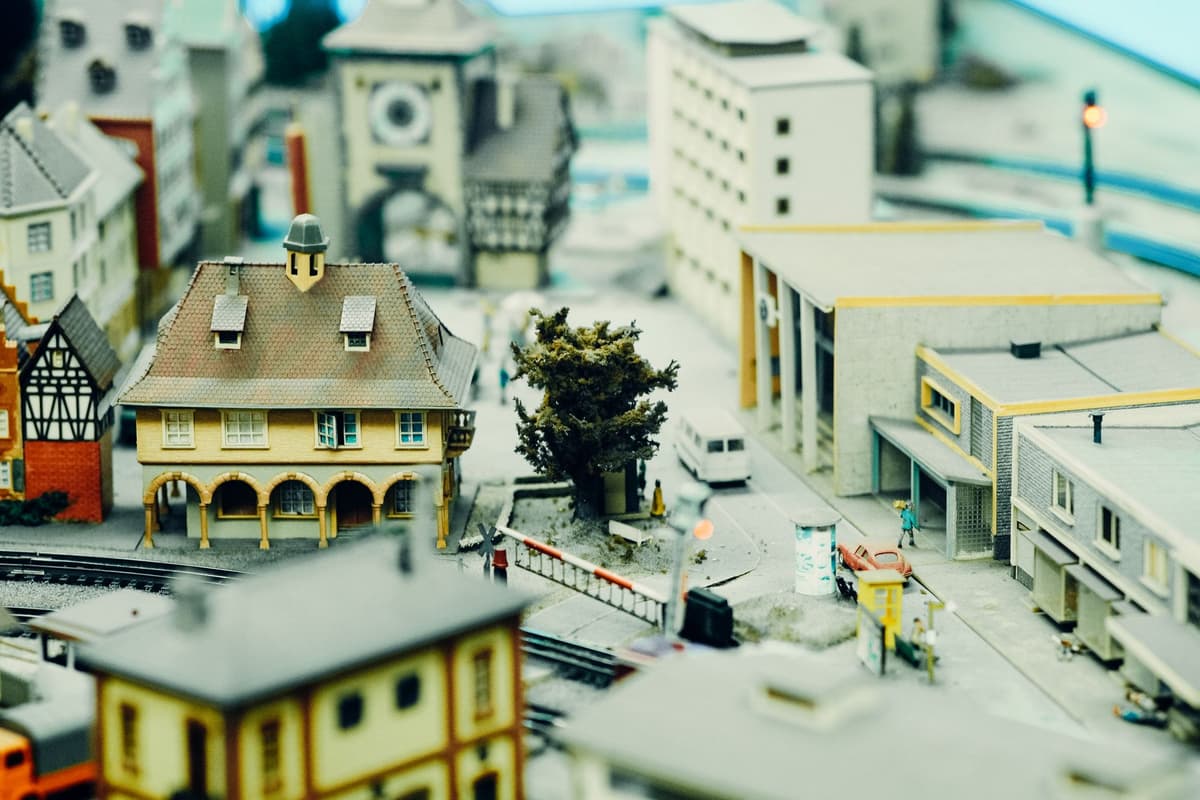
Photo by Ramon Karolan on Pexels
If you want to convince a city council to spend $40 million on coastal sea walls, showing them a spreadsheet of projected tidal surges gets you blank stares. Showing them a hyper-realistic simulation of their favorite artisanal sourdough bakery getting submerged by three feet of digital Pacific Ocean gets the funding approved before the meeting even adjourns.
What This Actually Means
The real power of playable city models isn't that they look cool. It is that they democratize access to the invisible rules that shape where we live. For a century, zoning and civil engineering have hidden behind impenetrable jargon and two-dimensional blueprints that require a master's degree to interpret.
When you turn a city into a sandbox, you strip away the bureaucratic obfuscation. Anyone who can hold a controller or click a mouse can understand density, transit flows, and shadow envelopes. It transforms urban design from an insular debate among consultants into something open to anyone who has to live with the consequences.
We are building the holodeck for local government. Just pray that whoever has administrator privileges remembers not to turn on the disaster physics during regular business hours.
Quick Answers
Is the city actually running on a video game engine?
Yes, many modern digital twin platforms use Unreal Engine or Unity because these engines are already optimized for massive real-time 3D environments and physics.
Can regular citizens play in these models?
Several pilot programs in Europe and North America are setting up public web interfaces or library kiosks where residents can explore proposed developments and toggle project features before public votes.
Does this completely eliminate bad urban design?
No, because software can accurately simulate human physics, but it still cannot fix bad political incentives or local budget shortfalls.


