
From Cathodes to Carrots
I’ve been watching the 'Discovery Loop' concept for a few years now, mostly in the context of guys in white labs trying to find a battery chemistry that won't explode or die after three hundred charges. It’s a fascinating process: an AI simulates millions of molecular combinations, identifies the top candidates, a robotic arm physically synthesizes them, and the results are fed back into the model to refine the next batch. It’s an accelerated evolution of matter. But lately, this loop has jumped the fence from electronics into the dirt, and I can't stop thinking about what happens when we treat the ground as a programmable interface.
We are talking about 'Software-Defined Soil.' This isn't just about adding fancy fertilizers to a field. It’s about building designer substrates from the molecule up—synthetic mediums that look nothing like the mud in your backyard. These materials are engineered to have specific porosities, ionic exchange rates, and moisture retention levels that traditional topsoil could never achieve. If we can design a semiconductor to move electrons with perfect precision, why can't we design a substrate to move nitrogen with that same level of control?
The End of Arable Anxiety
The math of the planet is currently a bit terrifying. We have lost roughly one-third of the world's arable land due to erosion or pollution in just the last 40 years. We usually talk about this as an environmental catastrophe, which it is, but it’s also a hardware limitation. Our current 'hardware'—the Earth’s topsoil—is a thin, fragile layer that takes centuries to form. If we decouple the ability to grow food from the presence of that specific 12-inch layer of organic matter, the geography of human survival shifts entirely.
Imagine a world where 'good land' is a meaningless phrase. In this scenario, you don't need a fertile valley in California or the black earth of Ukraine. You just need a flat surface and the right synthetic substrate. These materials don't just hold the plant up; they act as a high-speed data bus for nutrients. By using AI to optimize the molecular structure of these substrates, we can create 'precision delivery' systems where a plant gets exactly what it needs, at the exact millisecond it needs it, with zero runoff. It turns farming into a closed-loop engineering problem.
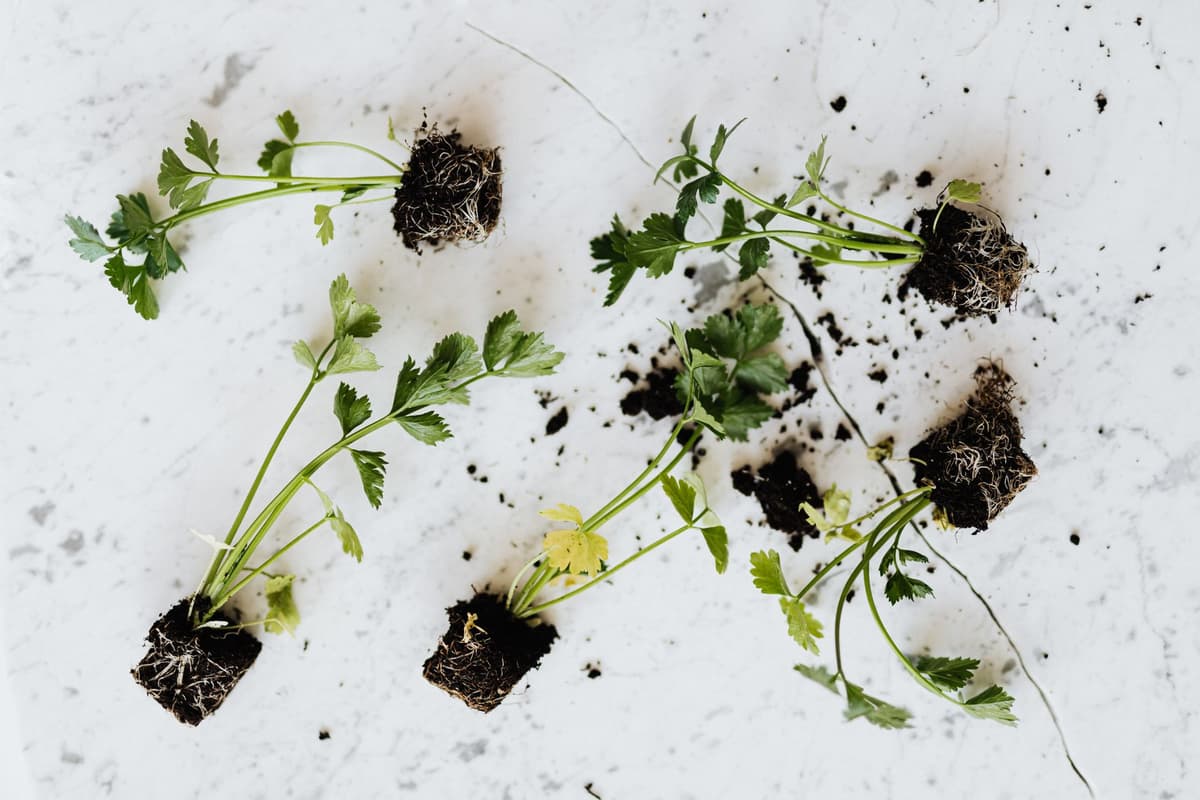
Photo by https://kaboompics.com/ on Pexels
The Molecular Geometry of a Salad
What really hooks me is the idea of 'precision nutrients' embedded directly into the material structure. Current farming is incredibly wasteful; we dump tons of nitrogen on a field, and most of it just washes away into the water table, creating dead zones in the ocean. It’s a blunt-force instrument. But what if the substrate itself was the fertilizer? What if the material was designed to release specific ions only when triggered by the chemical signals of a thirsty root?
This is where the material science gets weird and beautiful. Researchers are looking at metal-organic frameworks (MOFs) and specialized hydrogels that can be tuned at the atomic level. We are effectively building a custom 'motherboard' for every specific crop. A tomato plant requires a different support architecture than wheat. In the future, a farmer might not buy seeds and fertilizer; they might download a material specification and 'print' a field designed specifically for the genetic expression of a specific heirloom corn variety.
What This Actually Means
We are moving toward a reality where the 'naturalness' of our food is no longer defined by its connection to the Earth's crust. That’s a heavy philosophical lift for a lot of people. There is a deep, ancestral comfort in the idea of food coming from the ground, but we have to ask if that sentimentality is worth the massive environmental cost of traditional industrial agriculture. If we can grow 10x the food on 1/10th of the land using synthetic substrates that never erode and never leak chemicals into the ocean, is 'artificial' soil actually the more 'natural' choice for the planet's health?
This shift also changes the power dynamics of nations. If you can manufacture high-yield 'soil' in a factory in the middle of a desert or the middle of a city, the geopolitical leverage of breadbasket nations starts to evaporate. It’s a move from a resource-extraction economy to a knowledge-application economy. We aren't just planting seeds anymore; we are running a simulation of life inside a controlled, engineered environment.
I find myself wondering if something is lost when we move away from the chaos of real dirt. There is a whole microbiome in natural soil—trillions of bacteria and fungi—that we barely understand. Can an AI-driven discovery loop truly replicate the complexity of a billion years of evolution, or are we just building a very efficient, very sterile imitation? We are about to find out, because the first 'designer dirt' is already leaving the lab.
Quick Answers
Is this just hydroponics with a fancy name?
No, because hydroponics usually relies on water as the primary medium with inert support; synthetic substrates are 'active' materials that interact chemically and physically with the plant at a molecular level.
Will this make food taste like plastic?
Actually, by precisely controlling the micronutrients a plant receives during growth, scientists might be able to dial in flavor profiles and nutrient densities that are impossible to achieve in unpredictable outdoor soil.
When will we see this in actual grocery stores?
High-value crops like leafy greens and berries are already being grown in early versions of these substrates in vertical farms, but wide-scale adoption for staples like grain is likely a decade or more away due to cost.


