
The tech industry has spent the last forty years obsessing over miniaturization, convinced that the path to godhood lay in making things so small they effectively don't exist. Then Cerebras walked into the room with the CS-4, a processor that looks less like a microchip and more like a high-end floor tile. It turns out that if you want to simulate the birth of a galaxy without waiting three centuries for a cluster of GPUs to finish their little group chat, you just need to stop cutting the silicon into tiny pieces. It is the ultimate 'I’m not touching you' strategy for data.
Traditional supercomputing is basically a very expensive game of Telephone. You take thousands of standard GPUs, wire them together with enough copper to bankrupt a small nation, and then watch as 90% of your processing power is spent asking the chip next door if it’s done with its homework yet. The CS-4 solves this by being one giant, continuous slab of 4 trillion transistors. It’s the computing equivalent of a studio apartment—everything you need is within arm's reach, including the existential dread of realizing we are just simulating our way out of actually looking at the sky.
The Communication Tax is for Peasants
In a standard distributed cluster, the bottleneck isn't the math; it’s the commute. Electrons have to travel across motherboards, through PCIe slots, and over fiber optic cables just to tell the next node that a star just went supernova. By the time the message arrives, the simulation is practically legacy code. Cerebras decided this was inefficient, so they built the Wafer-Scale Engine (WSE-3), which keeps all 900,000 cores on a single piece of silicon. It turns out that moving data across a few centimeters of silicon is faster than moving it across a room. Who could have guessed that proximity matters?
This 'Zero-Latency' marketing fluff actually refers to the fact that the memory is physically integrated into the fabric of the processor. There is no 'going to memory.' The memory is already there, like a roommate who never leaves the couch. For astrophysicists, this means they can model galactic evolution with the kind of granularity usually reserved for things we can actually see under a microscope. We are now using 525,000 square millimeters of silicon to prove that gravity still works exactly the way Newton said it did, just with more decorative heat signatures.
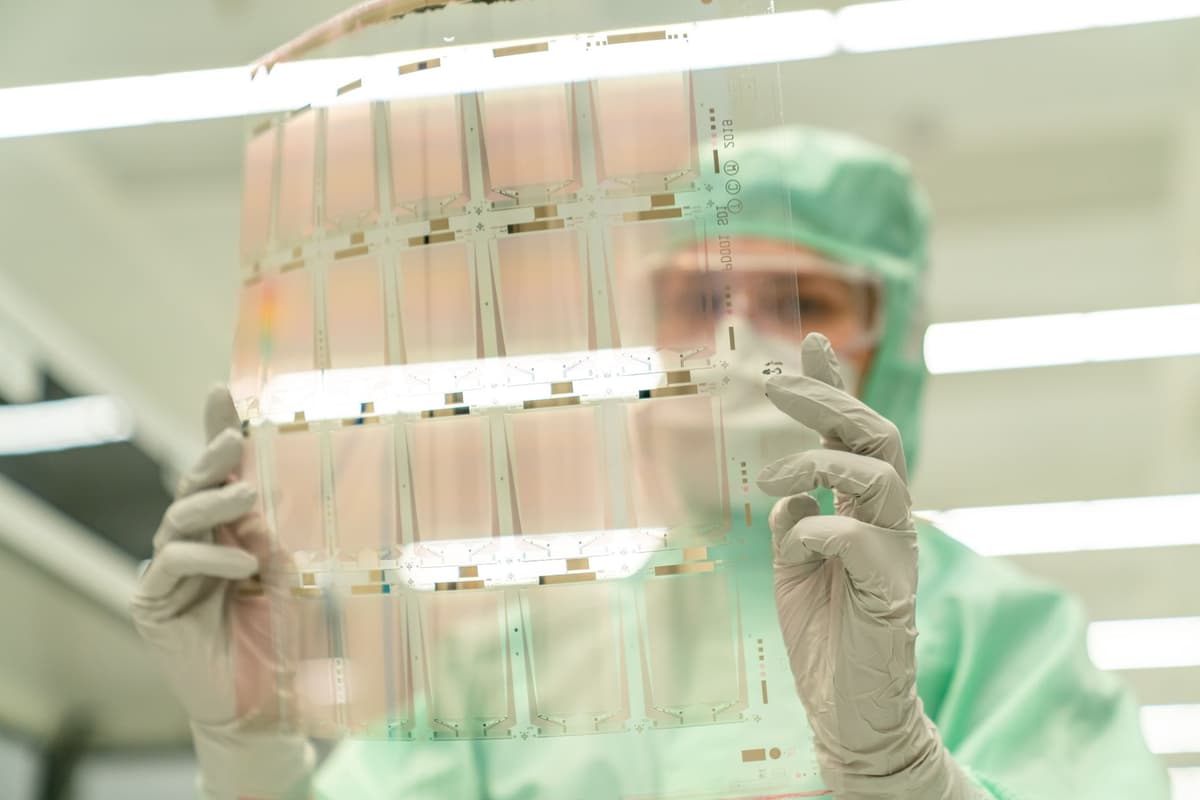
Photo by Российский центр гибкой электроники on Pexels
Simulating Everything While Solving Nothing
There is a certain irony in building a machine that can simulate 13 billion years of cosmic history in a weekend while we still struggle to predict if it will rain on Tuesday. The CS-4 is designed to handle models with trillions of parameters, which is a polite way of saying it can track every single dust mote in a nebula. Astronomers are giddy because they can finally bypass the 'communication bottleneck,' which is the technical term for 'waiting for Nvidia’s drivers to stop crashing.'
We are now at the point where our simulations are becoming more complex than the reality they’re supposed to represent. The CS-4 allows for 'granular detail,' which means we can see the individual burps of a black hole in real-time. It’s a beautiful, multi-million dollar way to confirm that the universe is mostly empty space and that we are, statistically speaking, an accounting error. But hey, at least the frame rate is high. If you're going to realize your insignificance, you might as well do it in 8K at 120fps.
The Power Bill of a Small Sun
Of course, nobody likes to talk about the cooling requirements for a chip that consumes 20 kilowatts of power. The CS-4 requires a dedicated internal water-cooling system that would make a Las Vegas fountain jealous. We are literally burning fossil fuels to simulate the fusion of hydrogen in distant stars. It’s a closed loop of irony: we use the energy from dead plants to power a giant toaster that tells us how the sun works.
This isn't just a chip; it's a space heater that occasionally does calculus. To keep this 12-inch slab of silicon from melting into a very expensive puddle of glass, Cerebras has to pump liters of coolant through it constantly. We’ve reached the peak of human ingenuity: building a fake universe requires almost as much energy as maintaining the real one, and the fake one doesn't even have better coffee.
What This Actually Means
Wafer-scale computing is the ultimate admission that we’ve hit a wall with traditional architecture. We can't make the transistors much smaller without them turning into ghosts (quantum tunneling is a buzzkill), so we're just making the chips bigger. It’s the 'Hummer' approach to computing. If the engine isn't fast enough, just make the engine the size of the entire car. It works, but it’s not exactly subtle.
For the scientific community, this is a genuine leap. Being able to run a simulation without the data getting stuck in traffic means we can test theories of dark matter and galaxy formation without waiting for a tenure-track position to open up. It turns out that when you stop making chips talk to each other over a wire, they actually get some work done. It’s a lesson in management that most corporations will strictly ignore.
Ultimately, the CS-4 represents our desire to play God on a 1:1 scale. We want a universe we can pause, rewind, and delete when it gets too complicated. We’ve traded the telescope for the wafer, and while the view is much clearer, it’s worth remembering that a simulation of a star has never actually kept anyone warm. Unless, of course, you’re standing directly behind the server rack.
Quick Answers
Is the CS-4 just a giant GPU?
No, it's one single piece of silicon the size of a wafer, whereas a GPU cluster is thousands of small chips connected by cables that hate you. It’s like the difference between a single massive steak and a pile of 5,000 sliders.
Why does 'Zero-Latency' matter for space?
Because when you're simulating a billion years of gravity, even a millisecond of lag between chips adds up to a simulation that finishes long after the actual sun has burned out.
Can it run Crysis?
It could probably simulate the entire development history of Crysis, the private lives of the developers, and the chemical composition of their lunch, all in about four seconds. But it doesn't have a HDMI out, so you're out of luck.


