I keep staring at the sea surface temperature charts from the last eighteen months and they look like a mistake. We’ve hit a streak where every single day has broken the previous record, often by margins that make climate scientists sound like they’ve seen a ghost. But what’s actually happening under that shimmering, overheated surface is a quiet decoupling of the biological gears that have turned predictably for millions of years.
It’s called a metabolic mismatch, and it feels like a glitch in the world’s oldest operating system. Phytoplankton—the microscopic green engines of the sea—are reacting to this heat differently than the fish that eat them. We are effectively watching the foundation of the global food web move into a different time zone than the rest of the occupants, and I can't help but wonder what happens when the bottom of the ladder simply isn't there when the next rung reaches for it.
The Engine is Redlining
Everything in the ocean is governed by the thermocline, that invisible boundary where warm surface water meets the nutrient-rich cold deep. Usually, winter storms churn this up, bringing a buffet of minerals to the surface just in time for the spring sun to trigger a phytoplankton bloom. But the water is getting so warm and so buoyant that it’s becoming a lid. The nutrients stay trapped in the dark, and the surface becomes a beautiful, blue desert.
When the water warms, the metabolism of cold-blooded creatures like fish and crustaceans actually speeds up. They need more fuel just to exist at their new, higher operating temperature. At the exact moment their environment is demanding they eat more, the phytoplankton populations are thinning out or blooming at the wrong time. It’s like being forced to run a marathon while someone slowly empties your pantry.
This isn't a slow slide; it's a synchronization error. In the North Atlantic, we’ve seen temperatures jump nearly 1 degree Celsius above the previous 30-year average in a single year. That sounds small until you realize the sheer amount of energy required to heat that much salt water. It’s the equivalent of hundreds of millions of Hiroshima bombs' worth of heat being dumped into the sink.
The Great Retreat to the Tank
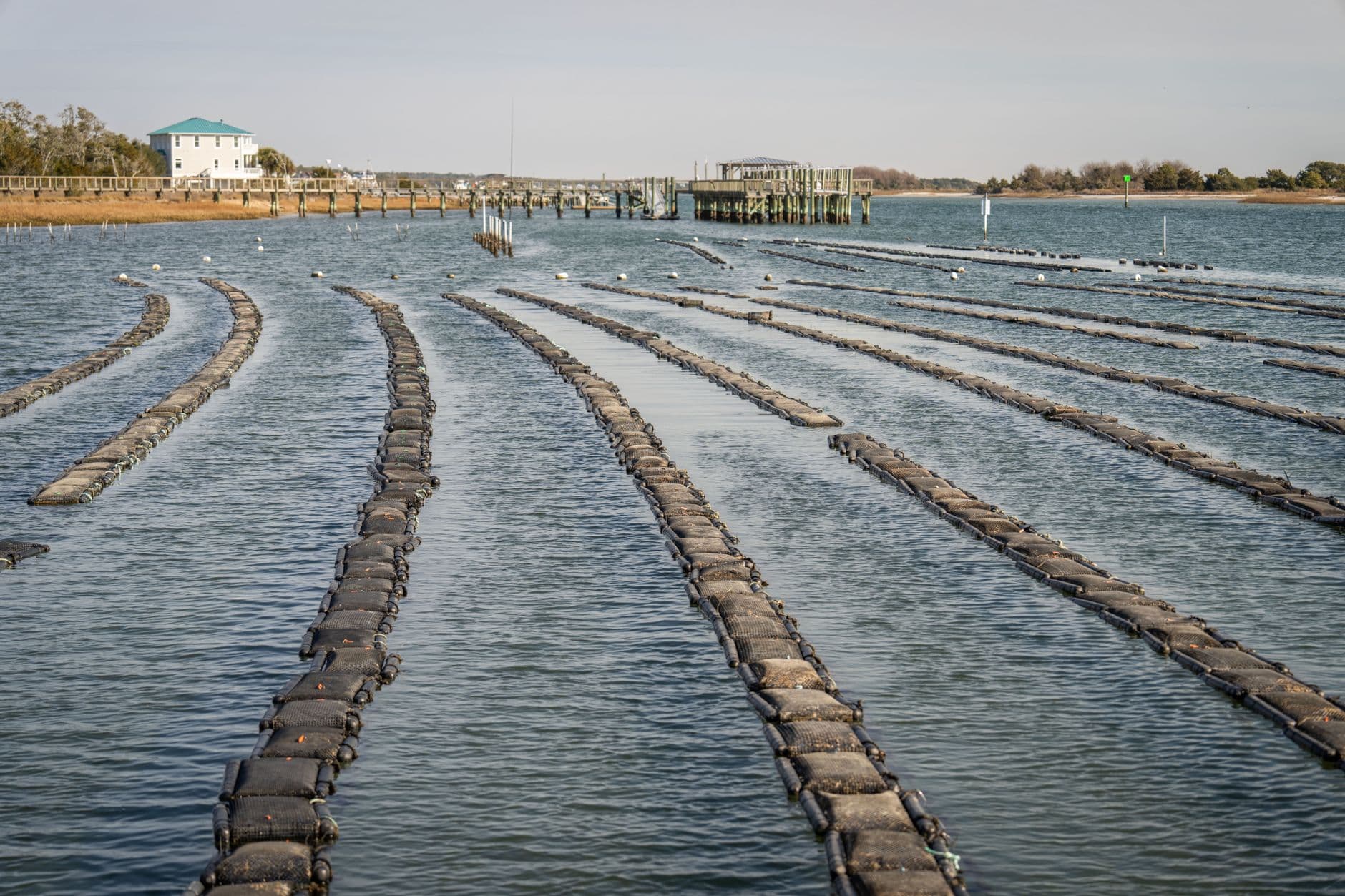
If the wild ocean is becoming too chaotic to rely on, where does that leave the $400 billion global seafood industry? I’m seeing a massive, quiet pivot toward what’s being called 'closed-loop' mariculture. We are essentially trying to build a version of the ocean that we can control, tucked away in massive concrete tanks on land or in highly monitored coastal pens.

Photo by Magda Ehlers on Pexels
There is something deeply strange about the idea of a salmon that never feels a current or a shrimp that grows up in a warehouse in the Midwest. We are untethering our food supply from the seasons because the seasons themselves have become unreliable narrators. In these closed systems, we control the 'thermocline.' We decide when the nutrients arrive. It’s an admission of defeat, in a way—a realization that the open sea is no longer a dependable partner.
But I wonder if we can truly replicate the complexity of a wild ecosystem in a filtered tank. Wild-caught fish are a miracle of concentrated solar energy and oceanic minerals. When we move them to land-based systems, we have to provide all of that ourselves. It turns food production into a pure engineering problem rather than a biological harvest.
Rethinking the Harvest
Maybe the most interesting part of this shift isn't the technology, but the change in our own expectations. For most of human history, the ocean was the last great wild frontier where we could simply go and take what we needed. We treated it like an infinite bank account that didn't require deposits. Now, the 'interest'—the natural reproduction of biomass—is failing because the environment is too stressed to keep up.
If we move toward land-based mariculture at scale, the very definition of 'seasonal' vanishes. We could have 'peak' tuna in February or 'fresh' oysters in a landlocked desert. It’s a level of food security that is comforting, yet it feels like we’re losing a fundamental rhythm. We are trading the mystery of the deep for the reliability of the plumbing.
I find myself questioning if this is the start of a total 'domestication' of the sea. We did it to the land 10,000 years ago, turning wild grasses into wheat and wolves into pugs. Are we about to do the same to the marine world? It seems we are building a secondary, artificial ocean because we’ve made the primary one too hot to handle.
What This Actually Means
The 'Thermocline Collapse' isn't just a headline for ecologists; it’s a fundamental shift in how humanity interacts with the planet's largest habitat. We are moving from a world of 'finding' food to a world of 'manufacturing' it. The record-breaking heat of 2023 and 2024 has acted as a catalyst, proving that the wild-catch model is too fragile for a volatile climate.
This transition to closed-loop systems will likely make seafood more expensive and more 'branded.' Your sea bass won't come from the Mediterranean; it will come from a specific facility with a specific carbon footprint and a specific nutrient profile. We are gaining consistency, but we are losing the ecological connection that made seafood unique.
Ultimately, we are witnessing the end of the ocean as a free lunch. As the metabolic mismatch widens, the gap will be filled by engineers, pumps, and filtered water. It’s a fascinating, slightly clinical solution to a mess of our own making. We are learning to live without the wild, one tank at a time.
Quick Answers
What is a metabolic mismatch?
It happens when predators (like fish) need more food because of warmer water, but their prey (like plankton) is disappearing or blooming at the wrong time.
Is wild-caught fish going away?
Not entirely, but it’s becoming far less predictable, leading the industry to invest billions into land-based 'factory' fish farms to ensure a steady supply.
Why does warm water stop nutrients from rising?
Warm water is lighter than cold water; when the surface gets too hot, it creates a physical barrier that prevents the nutrient-rich cold water from mixing upward.


