
Nobody likes to admit that the fate of industrial civilization rests on a set of 19th-century differential equations that literally nobody knows how to solve. We built $500 million supercomputers, pointed them at the atmosphere, and asked them to predict the next century of rainfall using the Navier-Stokes equations. The supercomputers looked at the math, wept silently in binary, and started rounding things off until a localized typhoon looked like a mild, pixelated misting over the Pacific.
Here is our dirty little secret: we are running global environmental diplomacy on an elaborate computational fudge factor. The fundamental equations of fluid dynamics are so monstrously difficult that the Clay Mathematics Institute offered a $1,000,000 bounty back in May 2000 just to prove whether smooth solutions always exist in three dimensions. Nobody has claimed the check. Yet somehow, we took that same unyielding mathematical wall, duct-taped it into global climate models, and used it to write municipal flood zoning laws in Florida.
The Grid Problem: Nature Doesn't Do Minecraft
To simulate the planet, computers cut the atmosphere and oceans into little cubes. Modern general circulation models like those used in the IPCC Sixth Assessment Report typically use grid cells roughly 100 kilometers wide. Think about that for eight seconds.
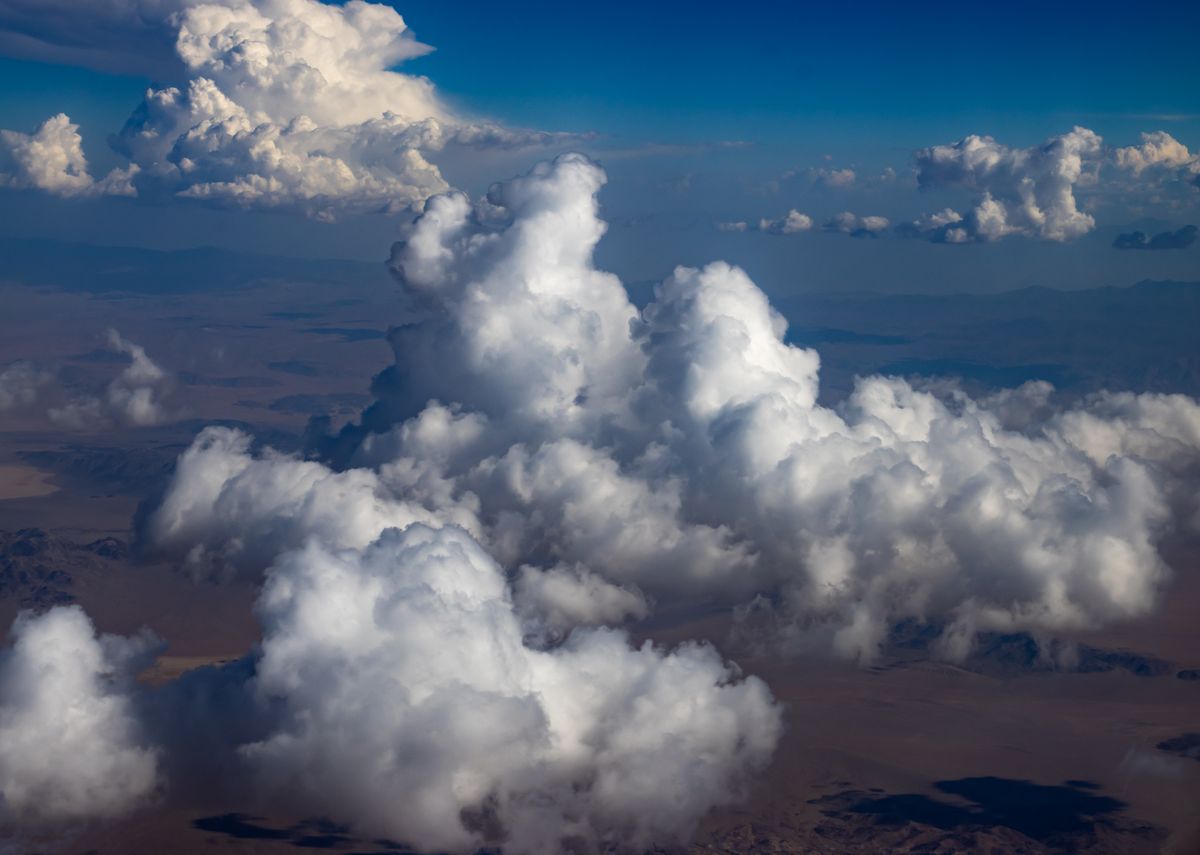
Photo by Ira Bowman on Pexels
A single thunderstorm cell is maybe ten kilometers across. Cumulus clouds are tiny, fluffy aerosol factories that operate on scales smaller than a neighborhood. Your average grid box sees an entire mountain range, twelve distinct microclimates, a sprawling city, and eighty thousand clouds, and treats them all as a single, homogenous tub of lukewarm air.
- Individual clouds do not exist to the computer; they are an abstract statistical vibe.
- Mountain peaks get sanded down into smooth, polite hills that don't upset the math.
- Ocean eddies that transport billions of gigajoules of heat are reduced to a single arrow pointing vaguely east.
- Boundary-layer turbulence is basically handled via mathematical vibes and historical guesswork.
When a model can't see clouds, scientists use "parameterization." That is an expensive, four-syllable word for an educated guess. Physicists write tiny sub-routines that tell the giant simulation: Hey, if this box gets hot and humid, just pretend there’s a cloud here and reflect 20% of the sunlight, okay? Don't ask questions. It is the meteorological equivalent of throwing a bedsheet over an unmade mattress and claiming the room is clean.
Turbulent Water Is an Absolute Monster
If air is annoying to simulate, water is a vendetta. The Navier-Stokes equations describe how fluids flow, but they completely fall apart into chaos the second turbulence enters the chat. In real life, turbulence is how kinetic energy cascades from massive planetary waves down into tiny microscopic swirls that turn into heat.
In our models, that cascade gets abruptly guillotined at the edge of the grid box. The simulation literally runs out of resolution, looks at the swirling ocean energy, and drops it into a computational shredder. The Atlantic Meridional Overturning Circulation (AMOC) — the massive conveyor belt of warm water keeping Western Europe from turning into a frozen post-apocalyptic tundra — relies on precise, fragile sinking regions off Greenland that are only a few miles wide.
Our models look at these narrow marine waterfalls and smooth them out into a gentle, lukewarm bathtub drain. Because the math smooths out the violence of actual water, the models consistently underestimate how fragile the currents are. We might be sitting around debating whether the conveyor belt stalls out in the year 2100 or 2150, while the actual, un-parameterized Atlantic Ocean is already packing its bags and planning an unscheduled sabbatical.
Bureaucrats Translating Smeared Pixels
Now take this glorious mess of approximations, round-offs, and unresolved vortices, and hand it to a room full of diplomats trying to establish a global carbon budget. This is where the comedy turns slightly tragic.
A climate model spits out an ensemble projection with a massive error bar because the underlying fluid dynamics couldn't resolve whether an atmospheric river would hit San Francisco or drift off toward Baja. But policy people hate error bars. Policy people want a crisp, laminated spreadsheet with a single number in cell C14.
So the nuances get sanded off faster than the Rocky Mountains in a low-res grid. Extreme precipitation events — which are inherently spiky, violent, localized Navier-Stokes freakouts — end up mathematically diluted into "a 4% average increase in seasonal moisture." A city planner reads "4% average increase" and buys slightly wider gutters. Then an actual atmospheric river rolls in, completely unbound by computational pixel limits, and deposits eight feet of water into their subway system overnight.
What This Actually Means
The issue is not that climate change isn't real. The issue is that reality is significantly more chaotic, jagged, and uncooperative than our neat digital graphs suggest. When we fail to resolve the terrifying math of fluids, nature does not politely default to the mild middle ground.
By hiding the Navier-Stokes breakdown behind elegant parameterizations, we have systematically biased our policy toward expecting smooth, gradual changes. We assume the climate warms like a dial being turned smoothly from one to ten. But fluid dynamics is not a dial; it is a stack of wobbly dinner plates balanced on the nose of a sea lion riding a unicycle.
We need to stop pretending that our models are precise crystal balls and start treating them like emergency flares. If the math says things are shifting, and we already know the math is blind to the wildest, most violent details of the system, the smart move isn't to haggle over decimal points on a carbon budget. The smart move is to assume the real storm is going to be a lot weirder, faster, and wetter than anything a 100-kilometer grid cell ever dared to dream.
Quick Answers
Are climate models wrong about global warming?
No, they get the broad planetary heating and thermodynamic trajectory remarkably right. They just struggle with the specific, messy fluid dynamics that dictate exactly when, where, and how hard the extreme weather hits.
Why can't we just make the computer grids smaller?
Every time you cut the grid box size in half, the computing power required jumps by a factor of sixteen because you have to calculate three spatial dimensions plus time. Simulating the entire globe down to one-meter resolution would require more energy than the planet produces.
What is Navier-Stokes in plain English?
It is a set of equations that says fluid movement follows Newton's laws of motion, accounting for pressure, viscosity, and external forces. It looks great on paper, but in 3D turbulent flow, it produces chaotic complexity that defeats exact mathematical solutions.

