Your Park Is a Narcissist
We have spent the last century building parks that act like they’re too good for us. You know the type: manicured flower beds that look like they’ve been styled with a protractor, gravel paths that punish you for wearing the wrong shoes, and those tiny 'Keep Off The Grass' signs that treat a blade of fescue like a sacred religious relic. It’s aesthetic gatekeeping at its finest. We’ve been conditioned to treat nature in the city as a museum exhibit where the only allowed activity is walking at a brisk, respectful pace while contemplating your own mortality.
Hamburg looked at that model back in 1914 and said, 'Nein.' They built the Stadtpark, a massive 148-hectare middle finger to the ornamental garden. While other cities were busy planting begonias that die if you look at them too hard, Hamburg was busy building a 'Volkspark'—a people’s park. It wasn’t designed to be looked at; it was designed to be beaten up. It’s the difference between a decorative bowl of wax fruit and a sprawling taco buffet. One is for show; the other is for survival.
The Architecture of Sweat and Sausages
If you visit the Stadtpark today, you’ll notice something radical: people are actually using it. I don’t mean they’re sitting on a bench reading The Economist. I mean they are grilling sausages, playing football, throwing frisbees that inevitably hit a stranger in the neck, and generally acting like mammals. The park features a giant circular meadow that is basically a 15-hectare invitation to chaos. It’s the anti-Versailles. Instead of rigid geometry meant to show off the power of a dead king, it’s a wide-open space meant to show off how bad your cousin is at badminton.

This isn't just about fun; it’s about social-ecological utility. By making the park a 'living room' for the city, Hamburg solved a problem that modern urban planners are still weeping over in their Moleskine notebooks. When people feel like they own a space, they actually show up. And when they show up, you get a high-density recreation zone that keeps people from losing their minds in their 400-square-foot apartments. It turns out that humans need more than just oxygen; we need a place to be loud and slightly sweaty in public without being arrested.
Cooling the Concrete Oven
Beyond being a great place to burn a bratwurst, this century-old design is accidentally a climate superhero. Modern cities are basically giant frying pans. We’ve paved over everything, and now we’re surprised that the air feels like a blowdryer in July. The Stadtpark acts as a massive air conditioning unit for Hamburg. Because it isn't broken up by unnecessary concrete 'ornamental' features, it creates a massive cooling effect that bleeds into the surrounding neighborhoods.
- It absorbs rainwater like a giant green sponge, which is great because nobody likes a flooded basement.
- The 'open meadow' design allows for wind circulation, which is fancy talk for 'it doesn't smell like hot garbage and despair.'
- The dense tree borders act as a sound barrier, so you can forget for five minutes that you live in a society.
We’re currently spending billions trying to 'innovate' climate-resilient cities, but the answer might just be 'stop planting stuff that breaks when a toddler steps on it.' Hamburg’s model proves that you don't need a high-tech vertical forest that requires a team of Norwegian botanists to maintain. You just need a lot of grass, some sturdy trees, and the courage to let the public use the space like they actually live there.
The Survival of the Chillest
There is a specific kind of urbanist who thinks every park needs a 'concept.' They want interactive light installations and interpretive dance spaces. But the Stadtpark’s concept is simply: 'Here is a big field, try not to kill each other.' It’s a low-maintenance, high-impact strategy that is miraculously resilient. When a park is built for utility, it doesn't 'go out of style.' A swing set from 1920 still works the same way in 2024. A flat piece of grass is the most versatile piece of technology ever invented.
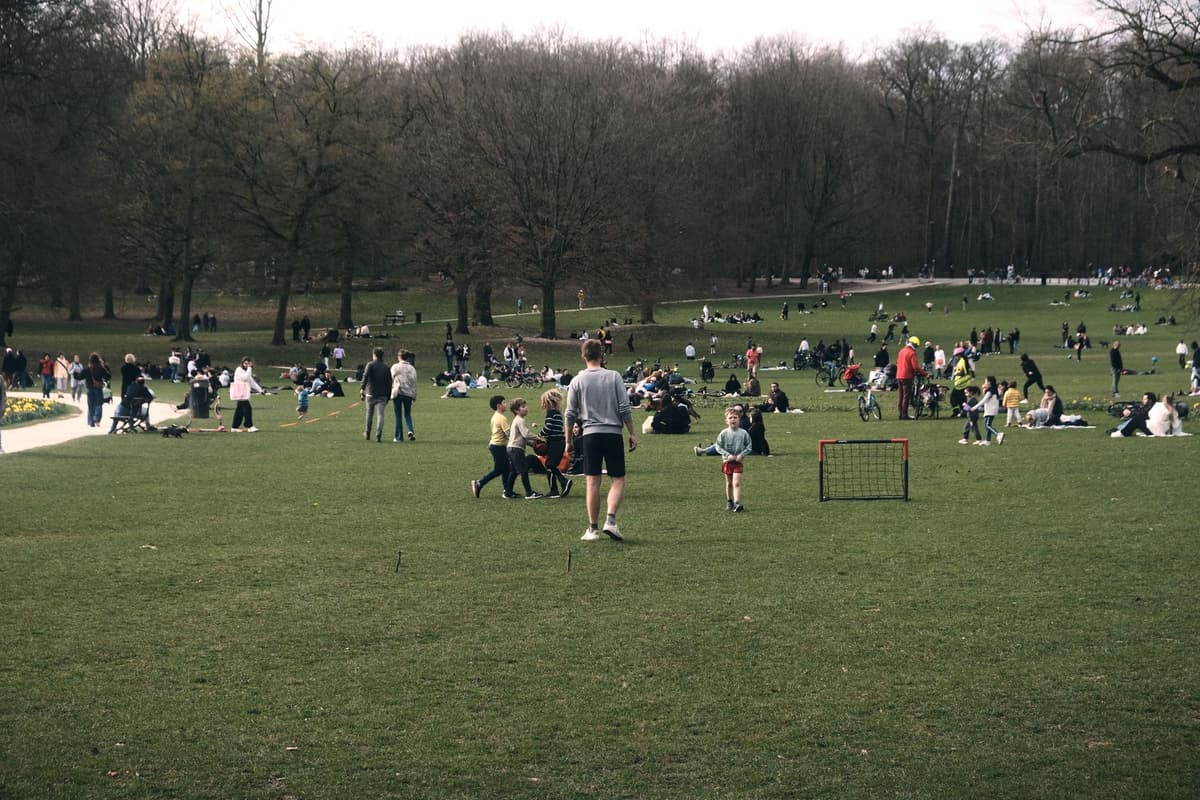
Photo by Mauricio Krupka Buendia on Pexels
If we want cities to survive the next fifty years of heatwaves and population booms, we have to stop being so precious about our landscaping. We need more 'Volksparks' and fewer 'Botanical Experiences.' We need places where the ecological benefit is hidden underneath a layer of picnic blankets and spilled soda. The future of the planet is literally a walk in the park—provided that park is built to handle your terrible athletic skills.
What This Actually Means
Hamburg’s Stadtpark is a reminder that the best design is often the most invisible. We don't need 'smart parks' with Wi-Fi-enabled benches; we need dumb parks with lots of room to run. By prioritizing human utility, Hamburg created a space that is ecologically robust because it is socially indispensable. People will fight to protect a park where they’ve spent their summers drinking beer; they won't fight for a decorative hedge.
This is the blueprint for the modern climate-resilient city. It’s not about adding more gadgets; it’s about subtracting the ego from urban planning. Give people a giant meadow, some shade, and the permission to be a bit messy. The environment wins, the citizens win, and the only losers are the people who sell 'Keep Off The Grass' signs.
Ultimately, a city that treats its residents like guests in a museum is a city that is failing. A city that treats its residents like the rightful owners of the outdoors—mud, noise, and all—is a city that might actually have a future. Go find a piece of grass and sit on it. It’s your birthright.
Quick Answers
Is the Stadtpark just a big field?
No, it has a planetarium, a lake, and woods, but the 'big field' is the heart of its social success because it allows for total freedom of movement.
Why is this better for the climate?
Large, contiguous green spaces cool the air and manage stormwater much better than fragmented, decorative gardens separated by asphalt paths.
Can other cities do this?
Absolutely, but it requires city councils to stop obsessing over 'visual order' and start embracing the messy reality of public life.


