
The $100 Billion Screen Door Effect
Imagine you are piloting a 200,000-ton container ship filled with premium air fryers and plastic lawn flamingos. You have two choices for staying on course: a complex network of 31 GPS satellites screaming data from orbit, or two pieces of metal with holes in them. If you chose the metal, congratulations, you are officially a 19th-century French physicist or a very frugal harbor master. We are unironically going back to Moiré patterns to guide ships, because apparently, the most advanced way to navigate the ocean is to recreate the visual equivalent of looking through a screen door at another screen door.
For the uninitiated, a Moiré pattern is that dizzying, wavy interference you see when two repetitive patterns overlap. It’s the reason news anchors aren't allowed to wear pinstripe suits unless they want the viewers at home to think they're melting into a strobe light. In the shipping world, this is being rebranded as 'Inogon' or 'Moiré Effect' beacons. It is essentially a giant, non-electric 'You Are Here' sign that changes shape based on your eyeballs' relationship to the shore. It is physics for people who think batteries are a scam.
No Plugs, No Problems, No Clue How It Works
These beacons are the ultimate 'dad' invention. They require zero electricity, zero maintenance, and zero satellites. It’s just physics doing the heavy lifting while we sit back and eat snacks. When a ship is perfectly on the 'leading line,' the captain sees a series of vertical black bars. If the ship drifts even a fraction of a degree to the left, the bars turn into arrows pointing right. It is quite literally a giant sign saying 'HEY STUPID, MOVE OVER.' It’s the maritime equivalent of those rumble strips on the highway that tell you you're about to die, but without the vibrating steering wheel.
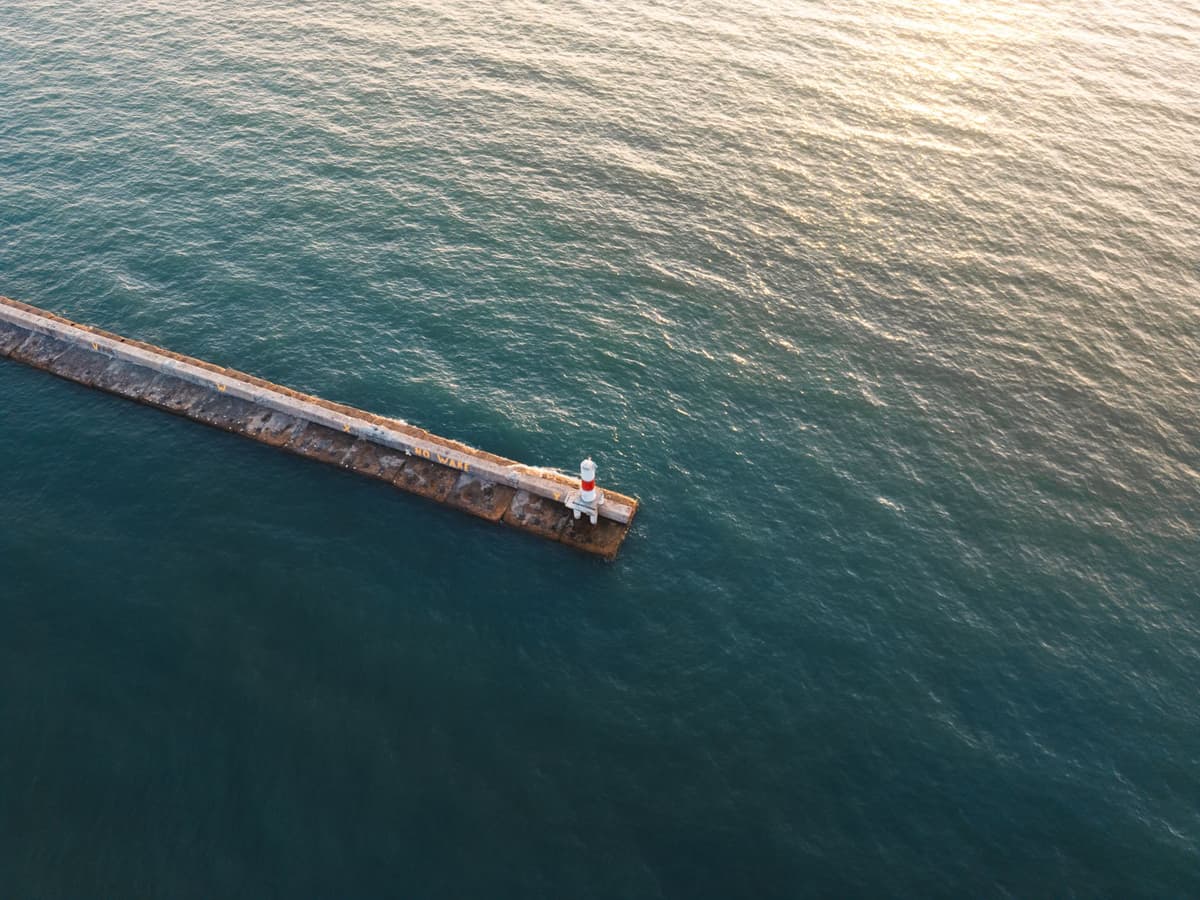
Photo by Willian Justen de Vasconcellos on Pexels
The beauty of this is the sheer laziness of it. We spend billions launching rockets into space so a guy in a tugboat can check his iPad, yet a couple of precisely machined grates can do the same job for the cost of a used Honda Civic. These things don't care about solar flares. They don't care if the grid goes down. They don't even care if you forgot to pay the electric bill. As long as the sun exists and you haven't gone legally blind, you can park a ship the size of the Empire State Building without hitting a single manatee.
Saving the Planet by Looking at Squiggles
Ecologically sensitive zones are currently littered with 'active' tech. We’ve got lithium batteries leaking into coral reefs and solar panels that seagulls treat like a very expensive toilet. By switching to passive Moiré systems, we are basically telling the ocean, 'We’re going to stop buzzing at you and just look at you really hard instead.' It's the most sustainable technology ever invented because it’s basically just a very smart fence. If we could solve climate change with a series of overlapping window blinds, we’d be living in a utopia by Thursday.
There is a specific kind of genius in realizing that we’ve over-engineered our way into a corner. We built a world where a software update can stop a ship from docking, only to realize that 1800s optics can do it better for free. It’s like buying a $500 smart-juicer that requires a Wi-Fi connection to squeeze an orange, then realizing you could just... squeeze the orange with your hands. The Moiré pattern is the 'squeezing the orange' of the maritime world. It is a low-tech middle finger to the cult of the lithium-ion battery.
What This Actually Means
This isn't just about ships; it’s a vibe shift in how we think about 'progress.' We’ve spent the last thirty years assuming that 'better' always means 'more chips, more sensors, and more things that beep when they're sad.' The resurrection of Moiré patterns proves that sometimes the best solution is the one that was sitting in a textbook from 1874 gathering dust. We are finally learning that sustainability isn't always about inventing a new green gadget; sometimes it's about deleting the gadget entirely.
Expect to see more of this 'Passive-Tech' movement. If we can guide ships with optical illusions, what else are we over-complicating? Maybe we don't need smart refrigerators that tell us we're out of milk; maybe we just need a glass door so we can look inside. The future of technology might look remarkably like the past, just with better branding and fewer kerosene lamps. And honestly? I’m here for it. Let the ships be guided by the magic of wiggly lines.
Quick Answers
Do these things work at night?
Yes, but you have to shine a light on them, which kind of defeats the 'zero energy' vibe unless you use a very powerful flashlight and a lot of upper body strength. Most modern versions use a single, low-power LED that lasts for a decade.
Can I use this to park my car?
Technically yes, if you want to bolt two giant metal grates to your garage door and look like a conspiracy theorist to your neighbors. It would be extremely accurate, though.
What happens if a bird poops on the pattern?
Then the 'arrow' might look a little chunky, but the physics remains the same. It’s significantly harder for a seagull to crash a Moiré beacon than it is for a solar flare to fry a GPS satellite.


