We are currently marshaling centuries of nonlinear partial differential equations to solve an existential civilizational dilemma: making industrial yellow pea paste feel slightly less like damp carpet when you chew it. The Clay Mathematics Institute famously posted a $1 million bounty in May 2000 for anyone who could prove whether smooth solutions to the three-dimensional Navier-Stokes equations always exist or whether they blow up into catastrophic singularities. It turns out the true frontiers of applied fluid dynamics do not lie in supersonic aerospace or fusion containment. They reside inside an industrial screw extruder outside Des Moines, frantically trying to prevent simulated chicken flesh from exploding into gray foam.
Food processing at scale has officially abandoned the pastoral romance of the farm and fully colonized the domain of terrifying non-Newtonian continuum mechanics. If you thought plant-based meat was just an earnest hippie soaking soybeans in a barn, welcome to the turbulence frontier.
The Million-Dollar Singularity Inside Your Fake Bacon
The fundamental Navier-Stokes equations govern how fluids move, from the swirling atmosphere of Jupiter to the arterial blood pumping through your heart. When fluids are simple and polite, like room-temperature water, we understand them well enough to build plumbing. The moment you introduce long-chain plant polymers, cross-linking starches, and isolated soy globulins, the math ceases to be polite. It becomes a hostile non-linear nightmare where viscosity changes unpredictably based on how hard you push it.
In pure mathematics, a "finite-time blowup" happens when a smooth, well-behaved mathematical field develops an infinite value at a finite point in time, essentially a mathematical black hole where the equations break down entirely. In an industrial food extrusion plant processing 5,000 kilograms of slurry an hour, an averaged Navier-Stokes blowup has a somewhat less theoretical outcome. It means localized shear stress spikes instantaneously, the viscous heating flashes trapped water to steam, and a steel dye worth $150,000 violently belches a blast of charred, rubberized muck across the cleanroom floor.
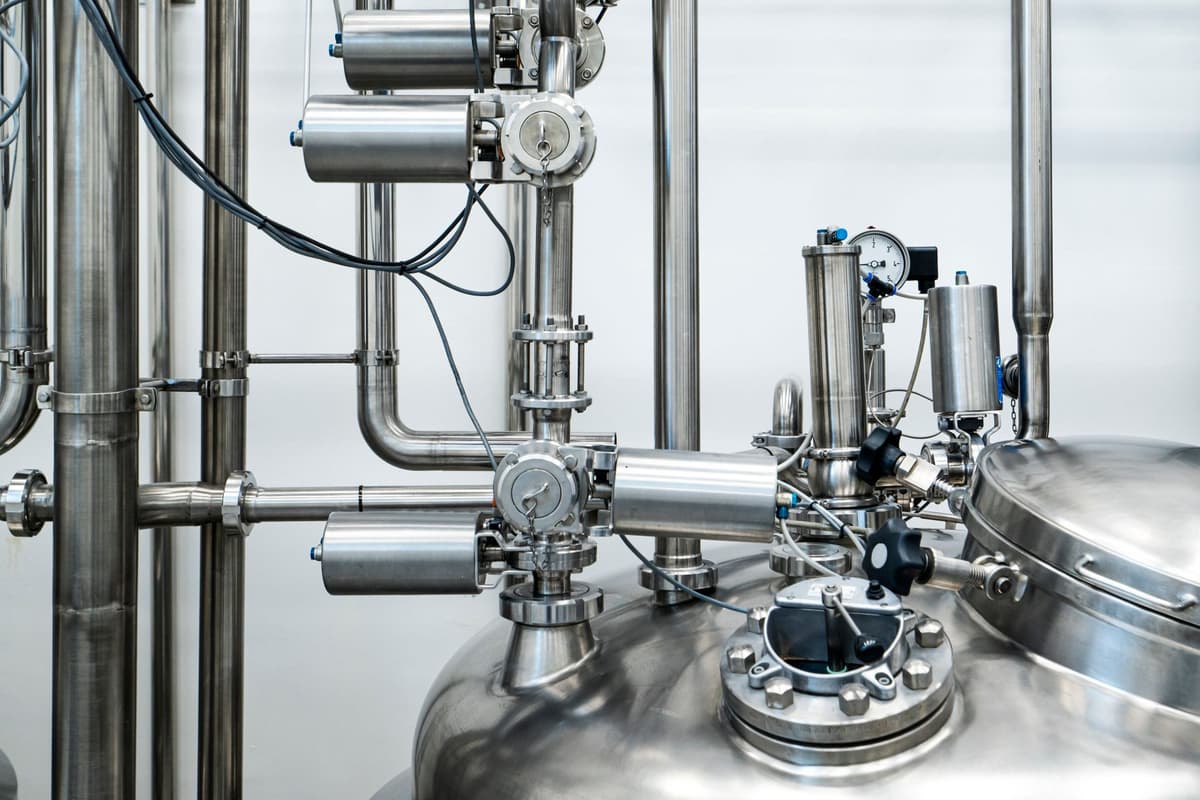
Photo by Policarpo Brito on Pexels
To make a plant-based protein strand look and tear like actual avian muscle, you cannot simply heat it up. You must subject the slurry to terrifyingly precise shear regimes inside twin-screw extruders. If the micro-vortices are two microns too wide, the protein matrices align into dense pencil erasers. If shear turbulence runs away, the emulsion breaks and you get an unmarketable paste that even a golden retriever would look at with mild pity.
The $8 Billion Battle Against Micro-Eddies
The venture capital gravy train poured over $8 billion into alternative protein startups between 2019 and 2022 under the naive assumption that extrusion is basically fancy Play-Doh. Software investors assumed you could scale a continuous texturization reactor the way you scale an Amazon Web Services cluster: just buy more compute. Then they discovered that fluid mechanics does not care about your seed round.
Scaling a texturizing bioreactor from a two-liter benchtop beaker to a 50,000-liter stainless steel vat changes the Reynolds number entirely. The pleasant, predictable laminar flow you had in the university laboratory instantly degrades into chaotic, anisotropic turbulence.
Here is how that physical reality ruins everyone's Monday:
- Shear-induced cell destruction: Cultivated animal cells in a giant vat do not have immune systems, bark, or skin. A single micro-eddy with an unlucky shear gradient will shred a million cow muscle cells like wet tissue paper.
- Viscosity inversion traps: Non-Newtonian oat emulsions thin under moderate pressure, then suddenly shear-thicken when pushed past a critical velocity, turning a pump into an accidental high-pressure anchor.
- Thermal hotspots and blowup: Local dissipation of turbulent kinetic energy causes wild micro-temperature spikes that denature proteins unevenly, meaning the left side of the extrusion stream turns into leathery jerky while the right side remains watery paste.
This is why your favorite synthetic burger still costs $9 at the supermarket and feels like seasoned chalkboard eraser. The companies making them are not failing at branding or sustainability messaging. They are losing an ongoing land war against nonlinear partial differential equations.
Solving Deep Physics so Milk Can Come from a Weed
There is something deeply poetic about the fact that humanity can split the atom, map the human genome, and send an autonomous probe to the outer edge of the heliosphere, yet we are brought to our knees by the rheology of a non-dairy creamer.
Consider the oat milk market, valued at $2.8 billion globally in 2023. Real cow milk is a masterpiece of natural colloidal engineering that stays homogenous for weeks without intervention. Oat slurry, by contrast, desperately wants to separate into gritty sediment at the bottom and cloudy gray water at the top. The only thing standing between your morning latte and an unholy suspension of swamp silt is an intense gauntlet of high-pressure homogenization running at 1,500 bar.
Photo by Mahmoud Atashi on Pexels
Engineers are now running supercomputer fluid simulations of micro-nozzle geometries specifically designed to harness Kolmogorov-scale turbulence. They are calculating the exact dissipation rate of turbulent kinetic energy required to shatter oat fat globules into sub-micron droplets without triggering cavitational shockwaves that erode the stainless steel manifolds. Newton, Euler, and Navier spent their lives wrestling with the fundamental mechanics of the cosmos, entirely unaware that the culmination of their intellectual legacy would be ensuring almond water does not feather when it touches hot filter coffee.
What This Actually Means
What this reveals, with crystal clarity, is our collective refusal to respect the sheer mechanical complexity of ordinary biology. We spent a decade listening to techno-optimists claim that animal agriculture could be replaced overnight by simply swapping slaughterhouses for fermentation vats, as if physics was merely a regulatory hurdle to be lobbied away. The meat industry did not spend the last century using living animals because cows are particularly efficient thermodynamic engines. It used them because an animal is an exquisitely self-regulating, self-repairing chemical reactor that handles its own fluid mechanics for free.
Replicating the micro-architecture of biological tissue requires solving some of the most obstinate, computationally brutal boundary-layer problems in mathematical physics. We will probably get there eventually. The mathematics of averaged three-dimensional Navier-Stokes solutions will creep forward, nozzle designs will optimize, and the non-Newtonian models will become sufficiently predictive to prevent expensive plant shutdowns.
When we finally achieve that glorious milestone, the prize will not be cheap space travel or infinite clean energy. The prize will be an engineered soy patty that tastes passably like a Tuesday night drive-thru hamburger, purchased at an astonishing intellectual cost that nobody eating it will ever comprehend.
Quick Answers
Why does fluid dynamics matter for fake meat?
Plant proteins must be aligned into linear fibers under immense pressure and shear to mimic meat grain. If the fluid turbulence in the machine is miscalculated, the protein either remains a flavorless paste or burns into rubber.
What is an averaged Navier-Stokes blowup in an extruder?
It is an uncontrolled, runaway spike in shear stress and localized viscosity where mathematical models fail and industrial equipment literally clogs, overheats, or blows a pressure seal.
Why can't startups just scale up their laboratory recipes?
Fluid mechanics behaves entirely differently in a 50,000-liter bioreactor than in a lab beaker because turbulence increases non-linearly with scale, easily tearing apart delicate cultivated cells.


