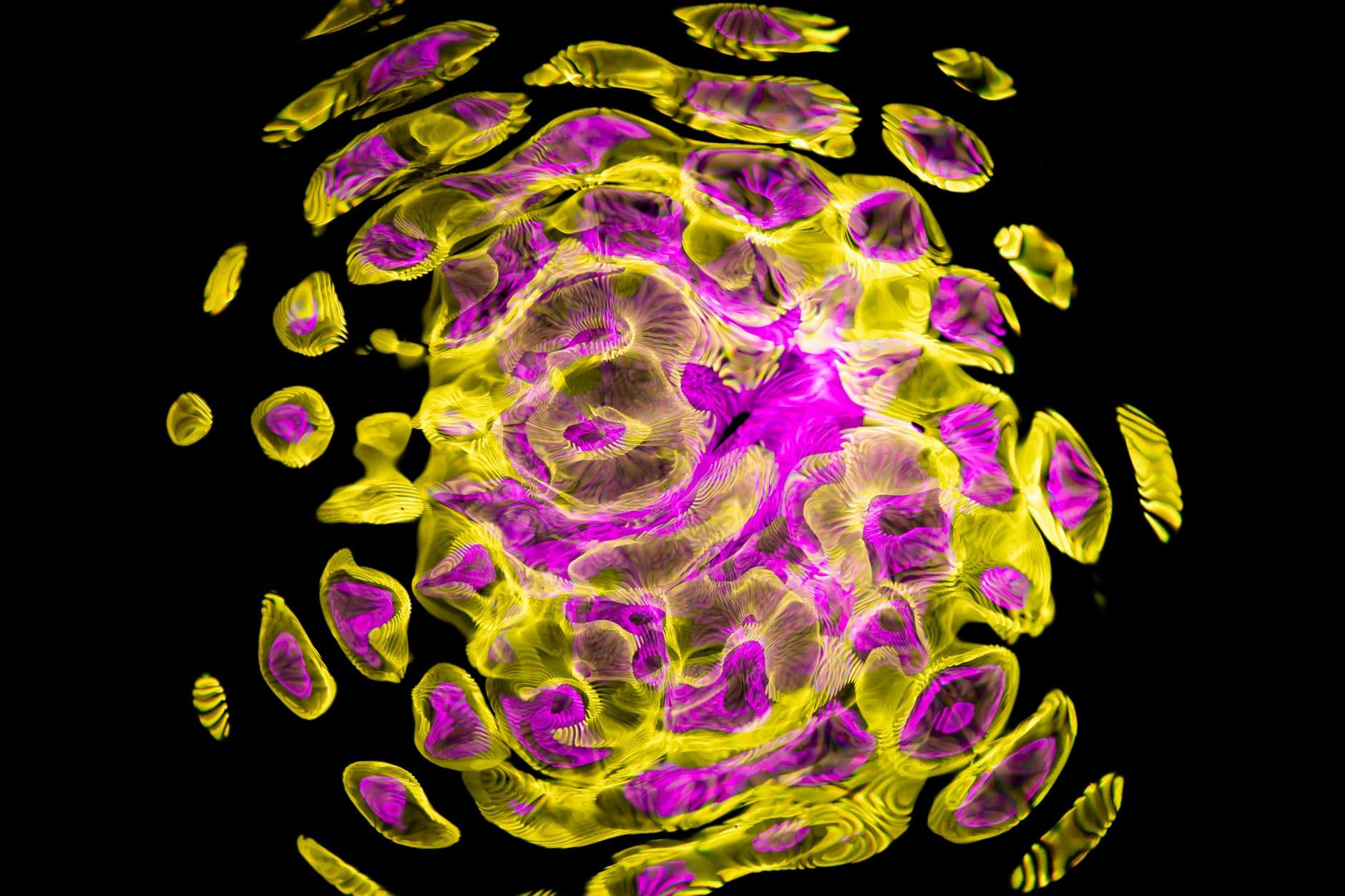
Physics Is Breaking Its Own Speed Limits
Everyone learns in high school that nothing goes faster than light, but that’s a lie told to people who can't handle the truth. The speed of light in a vacuum is the universal speed limit, sure, but light is a bit of a diva and slows down when it has to travel through water. It’s like a marathon runner who hits a swimming pool and starts doing a sluggish doggy paddle. Meanwhile, an electron—fuelled by the natural radioactive decay of Potassium-40 in the ocean floor—comes screaming through the water like a frat boy on a jet ski, actually outrunning the light particles around it.
When this happens, the universe throws a tantrum. It creates a 'sonic boom' but for light, resulting in a ghostly, electric blue glow known as Cherenkov radiation. If you’ve ever seen a picture of a nuclear reactor core looking like a Forbidden Gatorade commercial, that’s what we’re talking about. Except now we’ve realized this isn't just happening in labs; it’s happening in the deep sea, and the residents there are using it to hunt each other.
The Abyssal Arms Race Is Literally Glowing
Living in the deep sea is like trying to find a dropped contact lens in a dark room that is also trying to crush you with several tons of pressure. Most fish have given up on sight entirely, but a few overachievers have evolved eyes that are basically high-sensitivity satellite dishes. These creatures aren't just looking for bioluminescence—the standard 'glow-in-the-dark' stuff—they are actually spotting the faint, blue flickers of subatomic particles shattering the laws of physics.
It is a biological arms race that makes the Cold War look like a playground dispute. You have shrimp that can see individual photons of Cherenkov light, allowing them to treat the ocean floor like a minefield where the mines are made of glowing potassium. It’s the ultimate 'I see you' game. One organism uses the blue flash to spot a worm; the worm, presumably, tries to evolve into something that doesn't trigger a subatomic light show just by existing.
- Imagine a predator that doesn't need a flashlight because the floor itself is snitching on the prey.
- This isn't a steady light; it's a series of microscopic, blue strobe lights going off at random.
- It’s effectively a Luminous Speed Trap where the ticket for speeding is being eaten by a thing with translucent skin and too many teeth.
Potassium Is The Snitch Of The Sea
You probably think of potassium as the thing in bananas that stops leg cramps, but in the deep ocean, it’s a narc. Natural Potassium-40 is everywhere in the sediment. Every time an atom of it decays, it spits out an electron that pulls a 'Fast and Furious' maneuver, creating that blue flash. For a deep-sea crustacean, this is basically a motion-sensor light that tells them exactly where the buffet is located.

Photo by Riccardo Marchegiani on Pexels
Evolution is usually a slow, dignified process, but this is just petty. Nature saw a weird quirk of particle physics and decided, "Yes, I can use this to murder things more efficiently." It’s like finding out that spiders have learned how to use WiFi signals to track your location in the house. We thought the abyss was a silent, dark void, but it’s actually a high-tech surveillance state run by shrimp.
What This Actually Means
This discovery completely flips the script on how we understand deep-sea ecology. We used to think that below a certain depth, vision was a legacy feature, like the headphone jack on an iPhone—nice to have, but ultimately being phased out. Now we know that the very chemistry of the planet provides a permanent, albeit faint, light source that biology has been exploiting for millions of years.
It also means that the ocean is significantly weirder than we gave it credit for. We are looking for life on icy moons like Europa based on the idea that they might have similar radioactive heat sources. If those alien shrimp are also using Cherenkov radiation to find their lunch, we might need to start packing better cameras. We aren't just looking for life; we're looking for life that understands physics better than some undergrads.
Ultimately, it’s a humbling reminder that humans are the only ones who need a manual to understand the universe. The fish already figured out the subatomic speed limits and turned them into a dinner bell. We’re just the nerds standing on the shore with a calculator trying to catch up.
Quick Answers
Is the ocean floor actually a giant nuclear reactor?
No, it’s just full of naturally occurring isotopes like Potassium-40 that decay very slowly, making it more like a very weak, very large glow-stick.
Can humans see this blue glow underwater?
Unless you have the high-sensitivity eyes of a deep-sea predator and a total lack of concern for the crushing pressure, no, you'd just see pitch black.
Do the fish get superpowers from the radiation?
Sadly, no Godzilla-sized tuna have been reported; they've just evolved to be incredibly good at seeing tiny, blue flashes of light.


