
The Trace Geometry of a Soil Sensor
I spent yesterday looking at the wiring diagrams for a weed-zapping robot designed for a specific three-acre patch of rocky soil in Vermont. Usually, circuit boards look like city grids—orderly, right-angled, and clearly the product of a human mind trying to keep things organized. But the new wave of AI-assisted PCB (Printed Circuit Board) design is producing layouts that look more like a nervous system or a fungal colony. It makes me wonder if we are finally moving past the era of 'one size fits all' hardware and into something much more biological.
Traditionally, designing a ruggedized board for a farm takes months of back-and-forth between electrical engineers and fabricators. You have to account for vibration, heat, and the sheer hostility of a field. If you get it wrong, you lose a season. Now, we're seeing tools like Flux or Celus that can take a list of requirements and spit out a routed board in hours. It's not just about speed; it's about the fact that a $15,000 startup can now build hardware that used to require a $40 million R&D budget.
Solving the Ruggedization Paradox
Why does this matter for what you eat? Because the biggest bottleneck in agriculture isn't a lack of ideas; it's the 'hardware gap.' Big Ag companies like John Deere operate on multi-year cycles because the cost of spinning up a new hardware platform is astronomical. They need to sell 10,000 units of the same machine to make the math work. But every farm is a snowflake. A vineyard in Napa has nothing in common with a potato farm in Idaho, yet we try to solve their problems with the same heavy machinery.
When AI handles the tedious work of trace routing and component selection, the 'unit of one' becomes profitable. We are seeing the rise of micro-sensors that are tuned to the exact chemical composition of a single hillside. If you can design and ship a custom PCB in two weeks for $500, you don't need a massive corporate conglomerate to approve your project. You just need a soldering iron and a vision for better dirt.
- Automated routing handles the parasitic capacitance issues that usually plague amateur designs.
- AI can cross-reference thousands of component datasheets to find the one specific chip that won't melt in 100-degree humidity.
- The 'engineering bottleneck' is shifting from 'how do we build this?' to 'what exactly do we want to measure?'
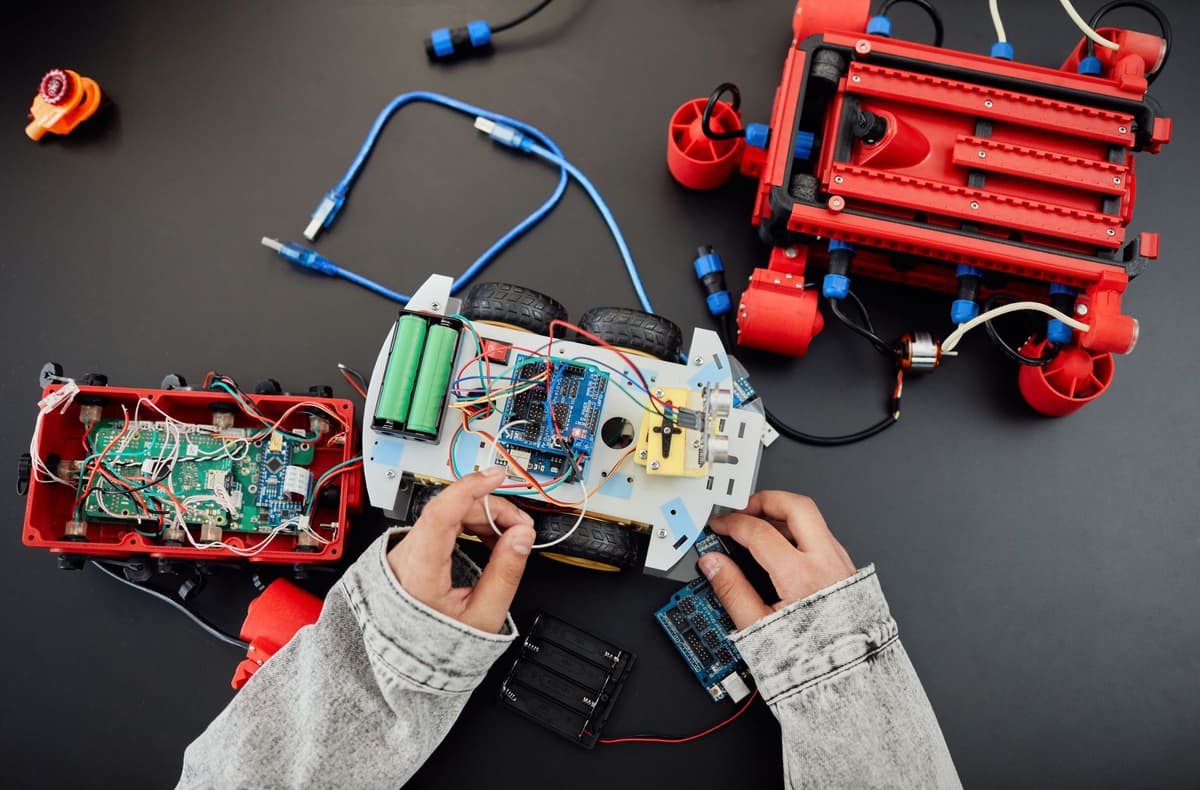
Photo by Vanessa Loring on Pexels
The End of the Multi-Year Cycle
I can't stop thinking about the timeline shift. If a pest outbreak hits a specific region, waiting three years for a manufacturer to update their sensors is a death sentence for a small farm. But what if the solution is a 'field-ready' pivot? We're seeing engineers generate schematics for specialized drone sensors in a weekend, getting them printed by Tuesday, and having them in the air by Friday. This isn't just faster manufacturing; it's a fundamental change in how hardware responds to the environment.
There's a specific kind of beauty in a machine that is built to exist for only one purpose in one place. We’ve become so used to the idea that 'tech' means a shiny, universal slab of glass and aluminum. But the future of food might look like a thousand different, slightly ugly, highly specialized robots, each one running a circuit board that no human could have been bothered to draw by hand. It’s a decentralized approach that feels much more like nature than a factory line.
What This Actually Means
We are witnessing the death of the 'General Purpose' farm machine. As AI lowers the barrier to entry for complex hardware, the power shifts from the people who own the factories to the people who understand the land. If you can generate a custom PCB as easily as you can generate a blog post, the physical world starts to move at the speed of software.
This isn't just about 'efficiency' in the corporate sense. It’s about resilience. A food system built on a million tiny, specialized sensors is much harder to break than one built on a few massive, proprietary platforms. I'm curious to see what happens when the farmers themselves start 'prompting' their tools into existence, bypassing the boardroom entirely. We're moving toward a world where the hardware is as diverse as the crops it protects.
Quick Answers
Can AI actually design a whole PCB yet?
It can handle about 80-90% of the routing and component placement, especially for standard sensor arrays, but a human still needs to check for 'sanity' and specific physical constraints. It’s currently more of a high-powered co-pilot than a solo pilot.
Why is this better than just using an Arduino?
Arduinos are great for prototypes, but they aren't 'rugged.' Custom PCBs allow you to shrink the footprint, manage power much more efficiently for solar use, and survive the literal vibrations of a tractor.
Will this make food cheaper?
In the long run, yes, because it reduces the 'input waste'—farmers can use less water and fewer chemicals when they have precise, real-time data from hyper-local sensors.


